
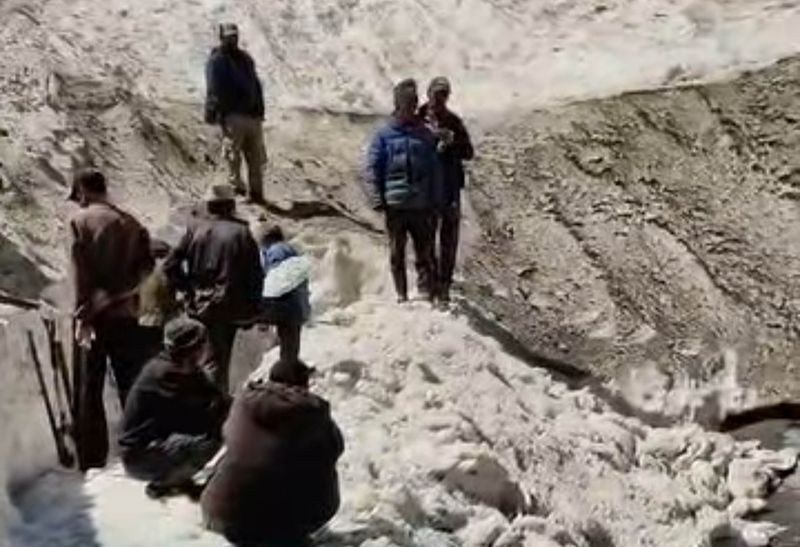
On Sunday, villagers battled harsh conditions for nearly three hours, manually carving a 200-metre-long stretch of ice and debris that had blocked their traditional irrigation channel, locally known as a kuhl. The obstruction, towering between 7 to 10 feet in height, had formed after heavy winter snowfall pushed glacial debris onto the waterway.
With the sowing season underway, access to water is critical. In Lahaul-Spiti, where rainfall is scarce, agriculture and horticulture depend entirely on these fragile irrigation systems fed by melting glaciers. Any disruption can threaten the entire cropping cycle.
“This winter, heavy snowfall caused glacier debris to collapse onto our irrigation channel,” said local resident Inderjit Bhanu. “We had no choice but to clear it ourselves to ensure water reaches our fields.”
The challenges in Rashel are not limited to irrigation. During peak winter months, the village struggles even for drinking water. For two to three months each year, freezing temperatures cause water pipelines to freeze solid, cutting off supply and forcing residents to endure severe hardship.
Former panchayat head Som Dev Yoki explained that such struggles are common across the region. “In Lahaul valley, rainfall is minimal. Farming here relies completely on irrigation channels. Every year after winter, villagers must repair these kuhls and remove glacier debris. It’s an annual battle against nature.”
Yet, despite the odds, the people of Rashel continue to persevere. Their collective effort, cutting through solid ice under extreme conditions, stands as a powerful testament to human endurance and community spirit in one of India’s harshest inhabited regions.
The Baisakhi Sale Plan offers an excellent value of 2 years of subscription + 6 months complimentary.
If you proceed with this purchase, your current monthly subscription plan will be immediately cancelled.
30?"green-strip-scroll":""}">n ${e.display_status||e.scheduleTime}n
30?"green-strip-scroll":""}">n ${e.display_status+", "+e.scheduleTime}n