
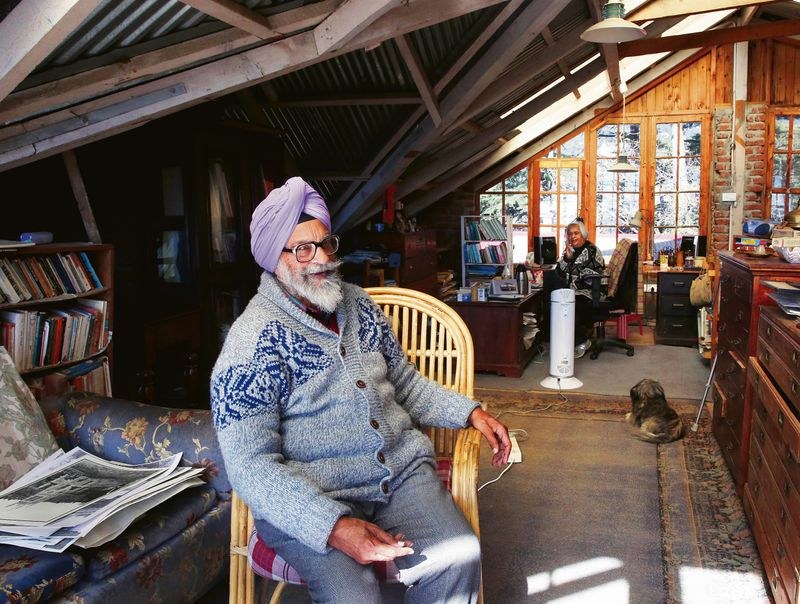
Billy was a fiercely individualistic and creative person. He tried to fit into the then ‘suitable’ career options — tea gardening in Assam, farming in UP, cultivating acrid land near the Nepal border, an apple orchard in Himachal. But it was in the pursuit of artistry and research of temples and traditions in Himachal that he found true happiness.
Initially, he painted watercolours, but later honed his inborn eye for detail and specialised in ink drawings of iconic architecture, painting the Taj Mahal in Agra to Mandu Fort in Madhya Pradesh.
Ever humble, he shunned display of his work, preferring to gift his individualistic works of art to appreciative family members.
He accepted commissions from state governments to immortalise tourist attractions, presenting unusual perspectives on world famous monuments. He once told me: “Everyone sees the basic structure; I try to focus on the detailing that is missed, or an angle that is not visible.” His coloured map of Shimla, which was commissioned in 1997 by the Ministry of Tourism, Himachal, and showcased the major tourist attractions and residences of eminent Shimla personalities, would once adorn most bureaucrats’ office walls.
Interestingly, Taj Mahal fascinated him. Perhaps this sprung from one of his favourite pieces of music, ‘A Night at the Taj’ by Ustad Vilayat Khan and Ustad Imrat Khan. His appreciation of the former led him to offer his cottage in Chhota Shimla to stay in the mid-1960s, while the maestro decided if he wanted to make Shimla his home.
Eventually, Ustad Vilayat Khan did stay on, making Parimahal, the erstwhile palace of the Jubbal royal family, his home for a few years. An unpublished work of Billy with etchings on the Taj Mahal remains as evidence of his research.
His intensive travels into the interiors of Himachal in his quest to document temple architecture and customs resulted in an extensive body of research, most of which remains unpublished, apart from a few articles. As the state convener for INTACH for decades, Billy was a hugely respected figure in the community, taking the lead in several restoration and conservation projects. His stature was undisputed and he served as a member of the HP government’s heritage preservation and tourism committees.
Dr Purnima Chauhan, former Secretary, Culture, recalls: “He once told me that Chhatru, which is en route from Rohtang pass to Chandratal Lake, was a starting point on the ancient Silk Route. I toured the area and we planned to present it to tourists. Billy scripted a concept note to get approval and funding.”
His elder daughter, Panita Virmani, says they plan to publish his research soon. “He also wanted us to make his research available to students; we are planning to establish a space in his home in Chhota Shimla for this.”
As a person, Billy was direct, without artifice. He had an innate ability to communicate with all manners of people, regardless of their social standing, establishing an instant rapport. Old Shimla residents will recall him striding to the Mall, walking the more than 4-km stretch from his picturesque cottage. Extremely social, the open house parties he and wife Sanjiv used to throw in the 1970s and ’80s were legendary.
His death leaves a vacuum in many lives; he was a true Shimla-ite, embodying the spirit of the hills. Respecting ecological constraints, he preferred to live without a car, living a simple yet very full life, giving back to Shimla much more than he took from it. In the words of Purnima Chauhan: “He drew inspiration from the space he lived in.”
The Baisakhi Sale Plan offers an excellent value of 2 years of subscription + 6 months complimentary.
If you proceed with this purchase, your current monthly subscription plan will be immediately cancelled.