
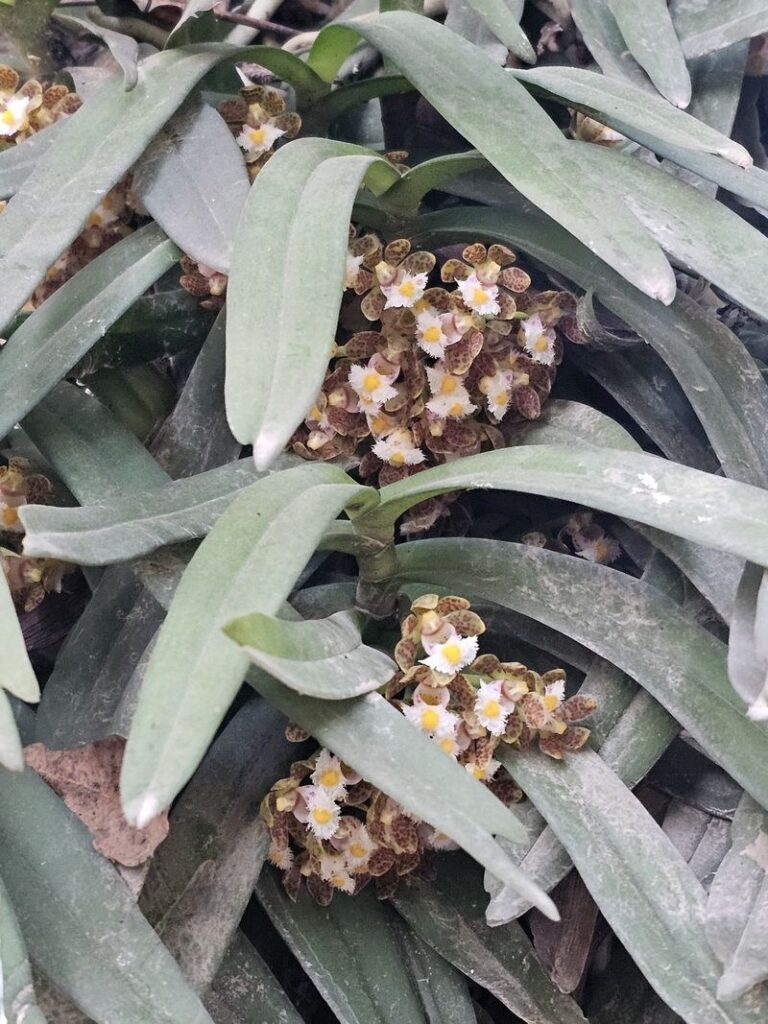
Over the past few decades, the Western Himalayas has witnessed rapid environmental change.
Expanding roads, forest fragmentation, fuelwood extraction and unregulated tourism have led to the loss of old-growth trees and disruption of forest structure. Climate change is compounding the crisis by altering temperature and moisture regimes. For a species so finely tuned to its habitat, even minor disturbances can prove catastrophic.
The story of Gastrochilus calceolaris is a quiet reminder that biodiversity loss does not always announce itself loudly. It often unfolds silently, high in the forest canopy, away from immediate human notice. But its implications are far-reaching.
Saving this orchid is not merely about preserving a single species. It is about protecting the ecological integrity of the Western Himalaya. If timely action is taken, this fragile yet resilient plant can continue to bloom in its natural habitat. If not, it may soon survive only in herbarium records — a loss that would echo far beyond the forests it once adorned.
Unlike terrestrial plants, Gastrochilus calceolaris does not grow in soil. It lives on the bark of mature trees, drawing sustenance from moisture in the air and organic debris trapped in moss and lichens. Such a lifestyle makes it highly sensitive to changes in its surroundings. It depends on dense canopy cover, high humidity and undisturbed forest conditions, features increasingly under threat.
The orchid does not rely on a single host species but shows a preference for old, rough-barked trees capable of retaining moisture. In the Western Himalaya, it is commonly associated with ban oak (Quercus leucotrichophora) and buransh (Rhododendron arboreum), along with other species such as Acer, Alnus and Prunus. These trees are not merely supports; they create the microhabitat essential for the orchid’s survival.
Field observations from Himachal Pradesh highlight its fragile distribution. The species has been recorded in the surrounding habitats of Mandi at around 1,000 metres, where it was found growing on Prunus species and in the forests of Kotli at about 1,300 metres. Though it can occur up to 2,700 metres under suitable conditions, such sightings are becoming increasingly rare.
The presence of Gastrochilus calceolaris is often an indicator of a healthy forest. Where it thrives, the ecosystem is typically mature, moist and biodiverse. Its disappearance, therefore, signals a gradual erosion of these vital conditions.
Yet, one of the greatest challenges in conserving this orchid is its invisibility. Unlike larger or more charismatic species, it rarely captures public attention. Its decline goes largely unnoticed and with it, opportunities for timely intervention are lost.
The need of the hour is a focused push for in-situ conservation — protecting the species within its natural habitat. This is where the Forest Department can play a decisive role.
First and foremost, conservation must begin with the protection of host trees. Mature ban oak, buransh and associated species should be identified, mapped and safeguarded. These trees, often decades old, support the moss-rich microhabitats essential for orchid establishment. Designating such patches as micro-conservation zones can help minimise disturbance.
Equally important is the maintenance of forest microclimate. Preventing excessive lopping, regulating grazing and controlling forest fires are critical steps. Even slight reductions in canopy density can lower humidity levels, making conditions unsuitable for epiphytes like Gastrochilus calceolaris. Simple, low-cost interventions can also aid recovery. Orchids dislodged from fallen branches can be carefully reattached to suitable host trees using biodegradable materials. Selecting shaded, moisture-rich locations on trunks can improve survival rates. Such assisted in-situ propagation techniques, if systematically implemented, can help stabilise declining populations.
Forest nurseries can complement these efforts by raising orchid propagules under controlled conditions, in collaboration with research institutions. At the same time, local communities must be engaged as active partners. Awareness initiatives can transform them into custodians of their natural heritage, ensuring long-term protection.
(The writer is Head of the Department of Botany at Vallabh Government College, Mandi, and a specialist in wild food plants)
The Baisakhi Sale Plan offers an excellent value of 2 years of subscription + 6 months complimentary.