
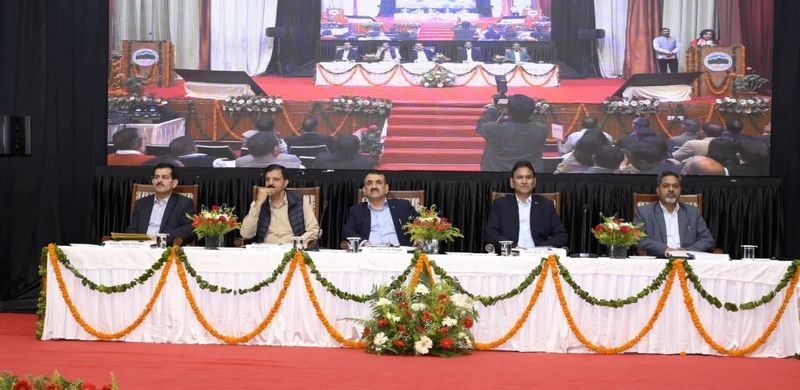
Kanwar said that from the academic session 2026-27, the framework will be operationalised to provide flexible, multidisciplinary and employment-oriented education. “A credit-based system will allow students to choose subjects based on their interests, enabling interdisciplinary learning such as a science student studying music or vice versa,” he added.
He said that undergraduate programmes would be structured based on student enrolment, with three-year degrees in colleges with lower strength and four-year degrees in those with higher strength. “Students of colleges with enrolment below 75 will be encouraged to seek admission to larger institutions for better opportunities,” he added
Kanwar said that teaching and evaluation would go hand in hand, ensuring transparency and quality. He added that an integrated digital portal with secure access would be developed, along with a unique student ID system to streamline migration and academic records.
Prof Mahavir Singh, Vice-Chancellor, HPU, stated that the NEP would be implemented from the current academic session, enabling students to benefit from the semester system and a flexible credit-based structure. “Students will have the freedom to choose interdisciplinary subjects across science, commerce, and humanities,” he added.
He said that colleges with lower enrolment would offer three-year degree programmes while those with higher enrolment would run four-year programmes. “Emphasis will also be laid on co-curricular activities and the development of a common academic calendar for adoption by both universities in the state,” he added. The Education Secretary stressed the need for an integrated digital portal, secure login systems and unique student IDs to facilitate academic mobility. He said that quality, data-driven research was essential.
The workshop featured three technical sessions during which discussions were held on the Academic Bank of Credits (ABC), nomenclature of certification, diplomas and degrees under the NEP, examination and evaluation systems, paper-setting structures and assessment schemes, importance of online learning platforms such as SWAYAM and MOOCs, internships, apprenticeships, project work and community outreach programmes.
Each session concluded with interactive question-and-answer segments, addressing participants’ queries related to the Undergraduate Curriculum and Credit Framework and the NEP.
The Baisakhi Sale Plan offers an excellent value of 2 years of subscription + 6 months complimentary.
If you proceed with this purchase, your current monthly subscription plan will be immediately cancelled.
30?"green-strip-scroll":""}">n ${e.display_status||e.scheduleTime}n
30?"green-strip-scroll":""}">n ${e.display_status+", "+e.scheduleTime}n