
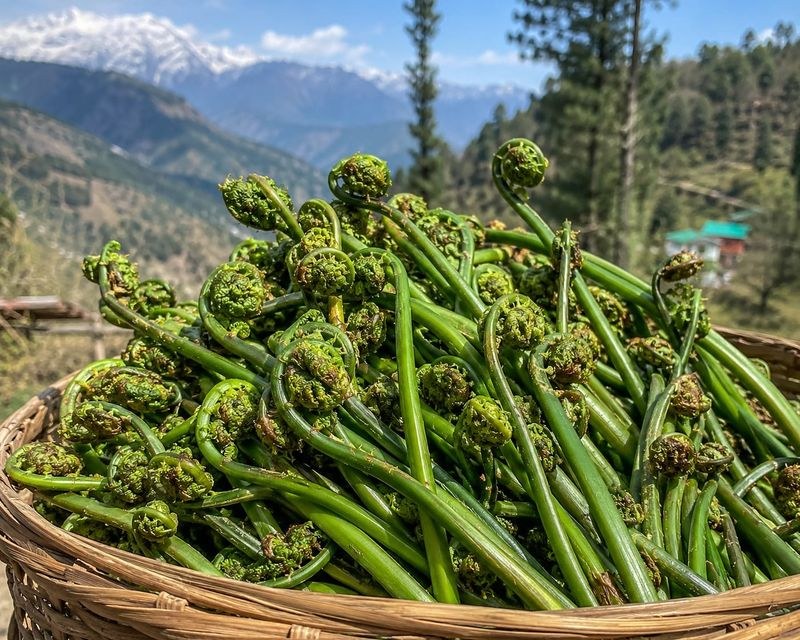
More than a seasonal delicacy, this humble plant has long been woven into the cultural, nutritional and economic fabric of the hill communities. Known in various regions as ‘Lingad’ or ‘Khasrod’, ‘Lungdu’ is available from April to September. It is valued for its rich nutritional profile of Vitamin A, B-Complex, iron, folic acid and fibre. Though mildly astringent in its raw form, its flavour transforms beautifully when boiled, making it a beloved ingredient in both curries and pickles in Himachal Pradesh.
The plant grows abundantly in Dhauladhar mountains, especially in the Dhar-Kandi belt of the Shahpur region in Kangra district and in high-altitude settlements around Dharamsala, Palampur, Baijnath and Barot-Bhangal. For many families, gathering ‘Lungdu’ is both tradition and livelihood. Women like Kanta Devi and Gudo Devi, both resident of Boh village recount arduous pre-dawn climbs to forests, often returning with 10 kg to 15 kg that they sell in local markets, a practice once rooted in barter, now an important source of income.
With rising awareness of its medicinal benefits, demand for ‘Lungdu’ has surged in rural and urban areas. Its dishes, especially ‘Lungdu ka Madra’, are now finding a pride of place in Kangri Dham and festive gatherings. Pickles prepared by local self-help groups are also becoming popular. Growing wild yet nurturing entire communities, ‘Lungdu’ stands today as a symbol of Himachal’s heritage, an enduring blend of taste, health, culture and resilience.
The Baisakhi Sale Plan offers an excellent value of 2 years of subscription + 6 months complimentary.
If you proceed with this purchase, your current monthly subscription plan will be immediately cancelled.
30?"green-strip-scroll":""}">n ${e.display_status||e.scheduleTime}n
30?"green-strip-scroll":""}">n ${e.display_status+", "+e.scheduleTime}n