
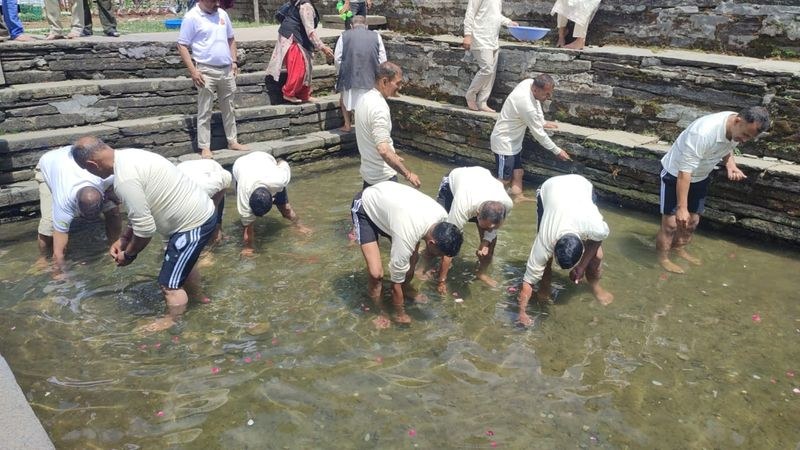
Home Guard volunteers are currently spearheading systematic efforts to restore neglected bowlis, ponds and check dams. Working in coordination with panchayats, forest departments and local residents, they have organised clean-up campaigns, removed silt and plastic waste, restored catchment areas, reopened natural runoff channels and undertaken plantation drives to stabilise slopes and recharge springs.
The initiative has also seen active participation from women and Mahila Mandals, who have helped identify forgotten bowlis, mobilise local communities and ensure their long-term maintenance.
Speaking about the initiative, Director General-cum-Commandant General of Home Guards, Satwant Attwal Trivedi, said, “In Himachal, water has always been regarded as a sacred life force. Springs were believed to be gifts of the gods, flowing through rock and forest to sustain human settlements. Most bowlis were therefore constructed in the presence of a local deity. A small shrine often marked the source, while peepal, ban or deodar trees stood guard beside it. Polluting a bowli was considered not merely unhygienic but a spiritual transgression believed to invite divine displeasure.”
She added, “Long before formal governance systems or sanitation laws existed, bowlis were governed by custom and conscience. The first water of the day was drawn for worship. Today, however, climate change has forced a reckoning. Summers are becoming longer and drier, springs are failing, pipelines are breaking down, and forest fires are increasing in frequency and intensity.”
“In this uncertainty, bowlis are being rediscovered not as relics of a romantic past but as pillars of resilience. They provide decentralised water security, require no external energy source, support livestock and biodiversity and act as emergency reservoirs during disasters,” she said.
Highlighting the impact of the initiative, the DG said, “The benefits are tangible. Revived water bodies are now supporting households, livestock and small farms. They also serve as critical water points during forest-fire response operations, reducing dependence on distant sources. Perhaps the most significant outcome, however, is the renewed sense of ownership, pride and collective responsibility among communities. By empowering local people, involving women and reconnecting communities with their natural heritage, this initiative is helping build a more resilient Himachal.”
Bowlis are traditional stepwells designed to harvest spring seepage and rainwater. Scattered across the hills of Himachal Pradesh, they reflect a deep understanding of terrain, geology and seasonal cycles. Their architecture is deceptively simple: a deep, stone-lined pit accessed through descending steps. The stones, often laid without cement, allow natural filtration and continuous percolation, ensuring the water remains clean and cool. The steps follow the changing water levels, guaranteeing access even during the driest months.
The Baisakhi Sale Plan offers an excellent value of 2 years of subscription + 6 months complimentary.
If you proceed with this purchase, your current monthly subscription plan will be immediately cancelled.
30?"green-strip-scroll":""}">n ${e.display_status||e.scheduleTime}n
30?"green-strip-scroll":""}">n ${e.display_status+", "+e.scheduleTime}n