
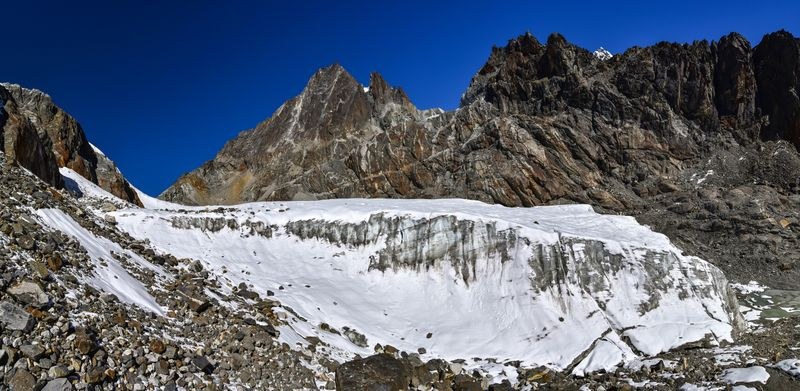
The NGT order comes in wake of suo motu notice taken on the basis of a news item ‘Study flags overlooked danger by hanging glaciers on mountain slopes in central Himalayas’ that appeared on April 20.
The NGT has sought response from the departments concerned a week before the next hearing by way of an affidavit. The matter is listed for hearing on August 8. The NGT has sought response from the Ministry of Environment, Forest and Climate Change, Central Pollution Control Board, Uttarakhand Tourism Development Board, National Mission for Clean Ganga, National Institute of Hydrology and Department of Urban Development, Uttarakhand.
Justice Prakash Shrivastava and Expert Member Afroz Ahmad in their order yesterday observed that the news item indicates violation of the provisions of the Environment Protection Act, 1986. “The news item raises substantial issues relating to compliance of environmental norms and implementation of the provisions of scheduled enactment. The power of the tribunal to take up the matter suo motu has been recognised by the Supreme Court in the matter of “Municipal Corporation of Greater Mumbai vs Ankita Sinha and Others”, the court observed.
The news related to danger posed by hanging glaciers on mountain slopes in Central Himalayas. Unstable hanging glaciers on steep mountain slopes could trigger devastating avalanches and downstream disasters, a new study focused on a sensitive section of the Central Himalayas has warned.
Four researchers from the Indian Institute of Science (IISc), Bengaluru, the Indian Institute of Technology (IIT), Bhubaneswar, and the Defence Research and Development Organisation (DRDO), Chandigarh, assessed such glaciers in the Alaknanda basin of Uttarakhand, a key headstream region of the Ganga.
Their findings revealed the scale of the growing but largely overlooked danger, and a sharp rise in human exposure, driven by rapid development in high-altitude areas. Himalayan states like Himachal face the threat of glacial lake outbursts flood (GLOF) due to accelerated glacial melting and increase in the number of glacial lakes in various river basins of Beas, Satluj and Ravi.
Using satellite imagery, elevation models and avalanche simulations, the researchers assessed the farthest potential ice avalanches could travel and their likely impact. They deduced that in the worst-case scenario, modelled flows could reach major settlements, including Mana, Badrinath and Hanuman Chatti.
The study estimated that built-up areas within vulnerable zones have expanded dramatically from about 8,000 sq.m in 2000 to over 1,50,000 sq.m projected by 2030. The Badrinath-Mana stretch showed the most striking growth with both population and infrastructure expanding towards steep glacier slopes. The researchers argued that adopting targeted monitoring in high-risk Himalayan locations could significantly reduce future risks.
The Baisakhi Sale Plan offers an excellent value of 2 years of subscription + 6 months complimentary.
If you proceed with this purchase, your current monthly subscription plan will be immediately cancelled.
30?"green-strip-scroll":""}">n ${e.display_status||e.scheduleTime}n
30?"green-strip-scroll":""}">n ${e.display_status+", "+e.scheduleTime}n