
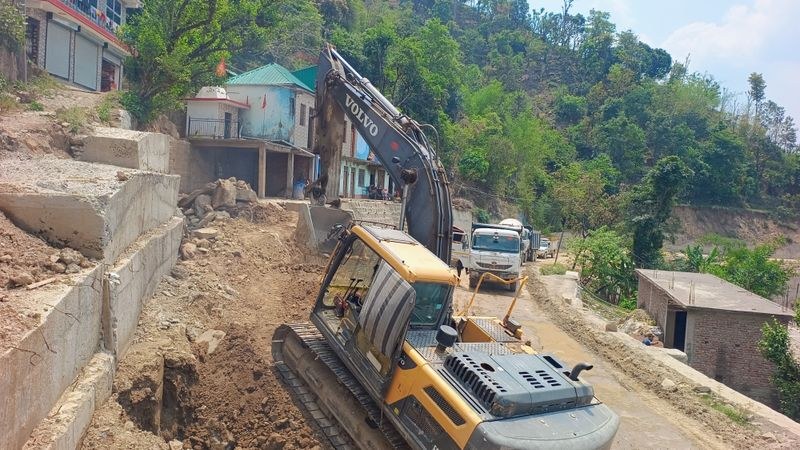
In Mandi district’s Dharampur subdivision, residents of Banal, Riyur, Khadela and Tapwalka villages say massive hill cutting, illegal dumping and delayed protection work linked to the Atari-Leh National Highway (NH-3) widening project have put their homes and livelihoods at severe risk.
The widening of major corridors across the state — including the Kiratpur-Manali four-lane, Mandi-Pathankot highway, Atari-Leh NH-3 corridor, and Shimla-Parwanoo four-lane — has transformed the Himalayan landscape. While the authorities tout these projects as symbols of development, residents and environmentalists warn of severe ecological and social costs.
In Banal village alone, nearly 18 houses remain vulnerable after excavation work destabilised the slopes above them. Villagers allege that despite repeated complaints and official inspections, critical protection work remains incomplete.
Former Zila Parishad member and Himachal Kisan Sabha leader Bhupender Singh, who recently visited the affected areas, accused construction agencies of blatant negligence.
“Illegal dumping of debris continues despite repeated objections,” Singh said. “During last year’s monsoon, muck from construction sites washed down toward Chalal and lower Dharampur, causing serious damage. The same danger looms this year,” he said.
The Riyur Scheduled Caste and OBC settlement, alongside families in Khadela, Tapwalka, and Banal villages, are among the worst hit. Residents — including Gyan Chand, Roop Lal, Pawan Kumar, Hans Raj, Des Raj, Sunil Kumar, Shashikant, Krishna Dev, Rajender Pal, Anoop Kumar, Beeri Singh, Shravan Kumar, Vipin Kumar, Meera Saklani, and Champa Devi — say extensive hill cutting has entirely compromised the stability of their land.
Last year, several families were temporarily evacuated to Riyur School after deep cracks developed near their homes. Some continue to live in rented accommodation.
“We were forced to leave because the hillside became unstable after road cutting,” said Meera Saklani. “Even after a year, no proper retaining wall has been built,” she said.
Echoing the anxiety, Gyan Chand said, “Whenever it rains, debris and stones slide downhill. We have repeatedly demanded safety walls and drainage channels, but the work is still incomplete.”
Beyond structural threats, villagers say construction has wrecked local infrastructure. “The company uprooted our roads, pathways, hand pumps and traditional water sources. Basic restoration has not been done,” alleged Jai Gopal Katwal, a local Himachal Kisan Sabha office-bearer.
Following severe damage during last year’s rains, a high-level inspection team visited the area on December 26 and 27. Officials directed the construction agency to complete pending retaining walls and safety measures by March. However, much of the work remains unfinished.
“The biggest concern is that retaining walls above the cut slopes are missing,” warned Bhupender Singh. “If these structures are not completed before the monsoon, many more houses will be destroyed,” he said.
The crisis in Dharampur reflects a wider environmental breakdown across Himachal Pradesh. Environmentalist Narender Saini emphasised that mountain infrastructure requires deep ecological sensitivity and scientific planning.
“The Himalayas are geologically young and fragile,” Saini explained. “Large-scale cutting without proper drainage weakens the terrain significantly. Combined with climate change and intense rainfall, these practices exponentially increase disaster risks,” he said.
While compensation has been provided to some displaced families who lost homes, shops and agricultural land, victims maintain it is highly inadequate. Public anger over the National Highways Authority of India’s (NHAI) oversight has also spilled into the political arena. Last year, Panchayati Raj Minister Anirudh Singh confronted NHAI officials after a five-storey building near an under-construction highway collapsed in Shimla.