
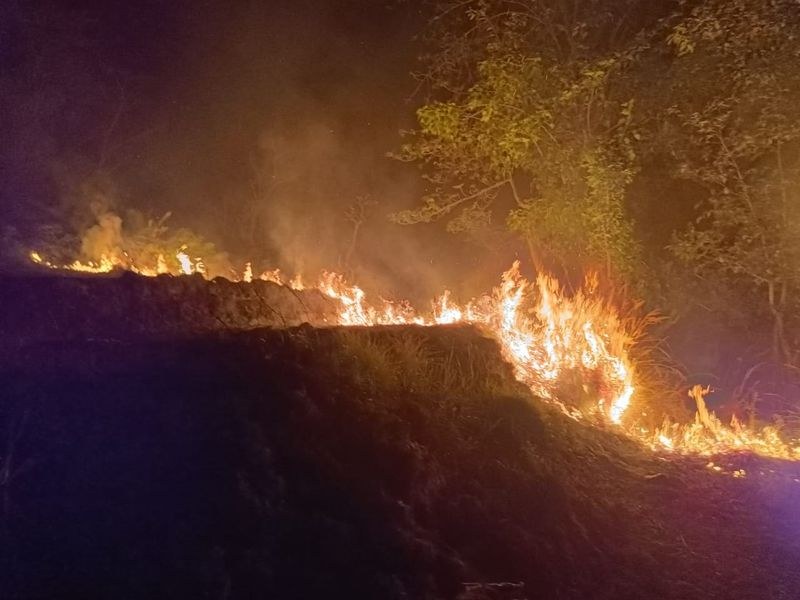
Vast stretches of forests in the Kangra valley and adjoining lower hill regions have been engulfed in flames, leaving behind charred trees, smoke-filled surroundings and severe ecological damage. The blaze has also threatened biodiversity, with many birds, reptiles and small animals believed to have perished or fled their natural habitats.
Officials said soaring temperatures and the accumulation of dry pine needles on the forest floor have created highly inflammable conditions. Chir pine forests are particularly vulnerable during the summer season, as fallen needles ignite quickly and help flames spread over long distances.
According to local residents, flames spread rapidly through forest belts near villages and roadsides, especially during afternoon hours when winds were strong. In several areas, villagers joined Forest Department staff to contain the fires using traditional methods, including beating flames with branches and creating fire lines.
A senior forest department officer told The Tribune that many incidents are man-made, caused either deliberately or through negligence. Burning of grasslands, discarded cigarette butts and careless human activity near forest areas are frequently cited as key reasons. The administration has appealed to the public to avoid setting fire to dry vegetation and to report any outbreaks immediately.
Divisional Forest Officer Palampur, Sanjiv Sharma, said the department has intensified surveillance in vulnerable zones to tackle the emergency. Fire watchers have been deployed, control rooms activated and field staff leave reportedly cancelled to ensure a round-the-clock response. Water tankers and communication equipment are also being used where possible.
Environmental experts K B Ralhan and Subhash Sharma warned that repeated forest fires pose a serious threat to Himachal Pradesh’s fragile ecology. Besides destroying trees and wildlife, fires damage soil fertility, increase erosion risks and reduce forests’ capacity to conserve water. Smoke pollution is also affecting nearby habitations and public health.
They added that climate change, erratic rainfall patterns and prolonged dry weather are increasing the frequency and intensity of forest fires in hill states. Unless preventive measures are strengthened, the damage is likely to worsen in the coming years.
Residents living near forest areas have urged the government to adopt a long-term strategy that includes community participation, improved equipment, early warning systems and strict action against those responsible. As flames continue to consume the state’s green cover, the need for urgent and coordinated action has become increasingly critical, they said.
The Baisakhi Sale Plan offers an excellent value of 2 years of subscription + 6 months complimentary.
If you proceed with this purchase, your current monthly subscription plan will be immediately cancelled.
30?"green-strip-scroll":""}">n ${e.display_status||e.scheduleTime}n
30?"green-strip-scroll":""}">n ${e.display_status+", "+e.scheduleTime}n