
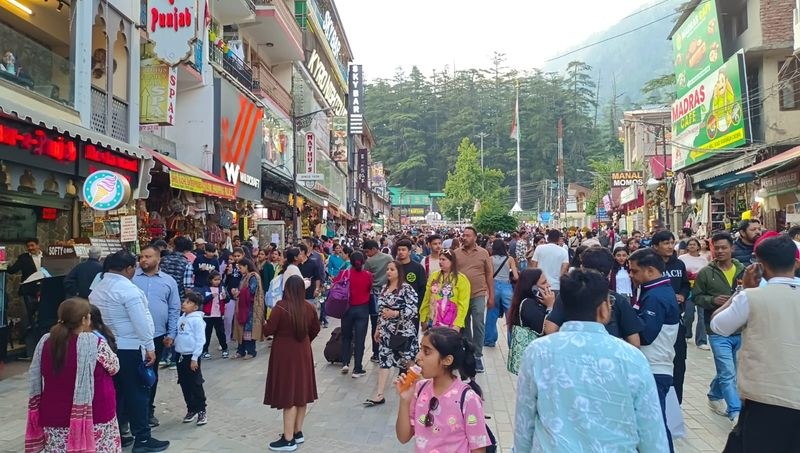
Hotels, homes and roads are increasingly being built along riverbanks or on unstable slopes — places that traditional wisdom often avoided. All the while, I kept wondering how the real purpose for which tourists from across the country and abroad come to these natural places has lost its true meaning altogether.
The crisis is most visible in places like Solang Nala, which has transformed from a pristine sanctuary into a zone of perpetual traffic congestion and a dumping ground for tourist waste. We are witnessing a systemic failure to balance economic gain with ecological limits.
Equally concerning is the cultural shift accompanying this transformation. Himachal is known as the land of deities. The mountains themselves are seen as divine. The towering ranges of the Himalayas are believed to be the abode of gods. Snow-clad peaks, dense forests, rivers and valleys are not just natural features — they are considered sacred presences.
What truly defines Himachal as Dev Bhoomi is how faith is inseparable from nature and daily life. Calling Himachal “Land of the Gods” isn’t just about mythology — it reflects a worldview in which nature is sacred and the community is guided by spiritual values. For centuries, deities in the Himalayas were believed to dwell in remote, elevated, and quiet places — high ridges, dense deodar forests and glacier-fed valleys.
The distance itself mattered. Reaching a shrine often required a steep climb, and that physical effort reinforced a sense of humility and reverence. Silence, isolation and difficulty were part of the sacred experience. There was a magical charm to these places, which seemed almost surrealistic.
I still remember my childhood journeys to the Shikari Mata shrine, which took nearly an entire day of steep climbing to reach. We would arrive utterly exhausted, yet the sense of fulfillment and the breathtaking experience made every step worthwhile. In our haste to make every religious shrine accessible, we have built roads to the very doorsteps of the gods. By replacing the silence with the roar of engines, we disturb the spiritual fabric of our mountains. There is a paradox: people come in larger numbers to express devotion, but the very act of mass access can disturb the pure spaces that made these places sacred in the first place.
We must ask ourselves: Is this sustainable? The fragile topography of Himachal Pradesh was never meant to bear this burden. By ignoring the limits of the land, we are effectively inviting the fury of nature. The catastrophic landslides and floods of the recent monsoon season were not mere accidents — they were warning signals. These disasters are not just about rainfall — they are about systems being pushed beyond safe limits. The consequences are becoming harder to ignore.
Collapsing roads, blocked highways, disrupted livelihoods and loss of life are stark reminders that the mountains have limits. When multiple landslides occur across districts, when roads collapse repeatedly, when rivers reclaim built-up areas, it suggests a pattern. The land is telling us where it cannot take more pressure; rivers are showing their natural flood boundaries and how they can change their courses.
Whether one sees it spiritually or ecologically, both perspectives converge on a similar idea: disrespecting natural limits has consequences. If we do not awaken from this deep slumber of complacency, these calamities will only intensify, threatening the very existence of the local population. It is high time the administration and citizens unite to enforce stricter building regulations, sustainable waste management, and a tourism model that respects our carrying capacity. We must act now to ensure that Himachal remains, in spirit and in truth, the Dev Bhoomi we claim it to be.
(The writer is an assistant professor, Department of English, Govt. Degree College, Khundian, Kangra)
The Baisakhi Sale Plan offers an excellent value of 2 years of subscription + 6 months complimentary.
If you proceed with this purchase, your current monthly subscription plan will be immediately cancelled.
30?"green-strip-scroll":""}">n ${e.display_status||e.scheduleTime}n
30?"green-strip-scroll":""}">n ${e.display_status+", "+e.scheduleTime}n