
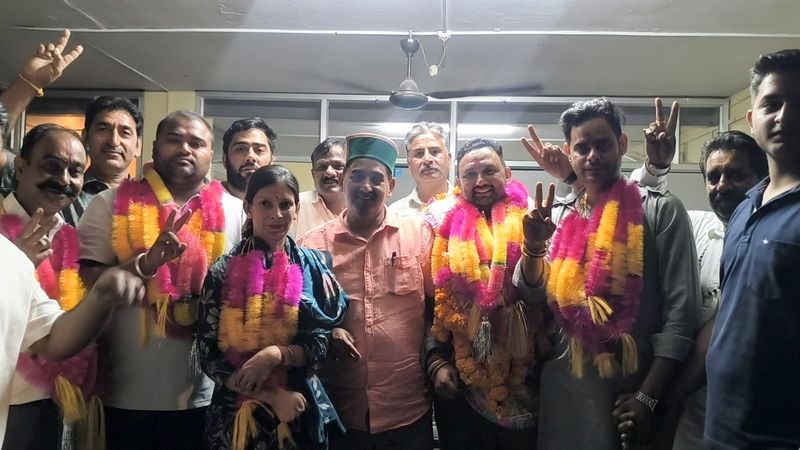
Despite being in power in the state and facing the usual burden of anti-incumbency, the Congress managed not only to retain its traditional urban pockets but also breach key BJP strongholds. The outcome indicates that organisational outreach and local leadership may still outweigh broader anti-government narratives in Himachal politics.
While retaining Kangra, Jawalamukhi and Shahpur was important for the Congress, its victories in Dehra and Nurpur are being seen as politically significant because both areas had increasingly tilted towards the BJP in recent elections.
In Nagrota Bagwan, though the Congress suffered a setback by winning only three of the seven seats, it is still set to get its post of president in the civic body as the seat is reserved for the SC category and only one Congress-supported candidate from that category has won.
The BJP’s performance in several urban local bodies exposed what political observers described as strategic miscalculations by the party leadership.
Banking heavily on perceived anti-incumbency against the Congress government, the BJP appeared to assume that public dissatisfaction over civic issues would automatically convert into votes in its favour.
Its decision to concentrate senior leadership and organisational machinery primarily on the high-profile Municipal Corporation contests in Dharamsala and Palampur left several municipal councils and nagar panchayats without strong political coordination—resulting in weak booth-level mobilisation.
In contrast, Congress leaders, ministers and workers remained continuously engaged in ward-level outreach, door-to-door campaigning and localised voter contact programmes. The party succeeded in turning the elections into contests centred on local accessibility and candidate-level engagement rather than broader state-level political dissatisfaction.
Political observers believe this “ground connect” became the Congress’ biggest strength in urban areas.
For the BJP, on the other hand, factionalism, organisational overconfidence and strategic miscalculations appear to have hurt the party in urban local body elections.
This was particularly visible in Dehra in Kangra and the Dalhousie Municipal Council in Chamba, where the Congress managed to wrest control from the BJP.
Observers attributed the BJP’s defeat largely to internal rivalry between factions within the party, which diluted campaign coordination and split organisational focus during the elections.
Meanwhile, in Chamba, the Congress is set to retain Chowari Nagar Panchayat and delivered what local leaders described as its best performance in Chamba Municipal Council in nearly 15 years, where it remained locked in a close contest with the BJP.
The results are likely to boost Congress morale in Kangra district, the state’s most politically influential region, which sends 15 legislators to the 68-member Himachal Pradesh Assembly.
In Himachal Pradesh politics, Kangra has often determined the direction of power in Shimla — and the latest urban verdict suggests the Congress has regained important political ground in the district.
The Baisakhi Sale Plan offers an excellent value of 2 years of subscription + 6 months complimentary.