
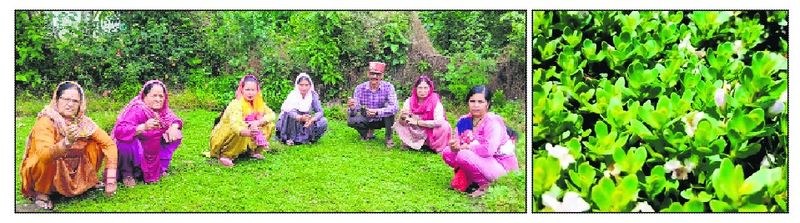
Under the Himachal government’s Mission Dhanvantari initiative, women associated with self-help groups (SHGs) have successfully adopted the cultivation of Brahmi (Bacopa monnieri), contributing to economic empowerment and promoting medicinal crop cultivation in the region.
Members of the Durga Shakti, Jagriti, Laxmi and Prerna self-help groups said they initially had little knowledge of Brahmi cultivation and lacked assured markets for the produce. Despite these challenges, they began farming the herb on a small scale with around 1,300 saplings.
Although returns were modest during the first year, the women continued their efforts with determination. With technical guidance and collective participation, Brahmi cultivation gradually expanded and has now evolved into a successful livelihood model.
In addition to selling fresh Brahmi, the groups have diversified into value-added products such as herbal candies, syrups, health drinks and medicinal preparations. These products have found a growing market, helping enhance household incomes.
Support from the CSIR-Institute of Himalayan Bioresource Technology (CSIR-IHBT) played a key role in the initiative. The institute provided planting material and technical expertise, enabling the women to establish a viable enterprise.
Initially, market access remained a major challenge. However, as awareness about the crop increased, companies began approaching the groups directly for procurement. One company reportedly assured the women that it would purchase their entire production, encouraging them to expand cultivation further.
The growth in production has been significant. Output increased from 12 kg in the first year to 70 kg in the second year and 122 kg in the third year. The crop is now harvested three times annually, ensuring a regular source of income.
Fresh Brahmi is supplied to Haryana and other states for use in Ayurvedic medicines, herbal beverages and health products. Farmers receive between Rs 200 and Rs 250 per kilogram for fresh produce, while dried Brahmi can fetch up to Rs 1 lakh per quintal. The groups also supply planting material to other farmers at around Rs 180 per kilogram.
What began with two self-help groups in 2022 has now expanded considerably, with several more groups joining the initiative. The growing awareness of its economic potential has encouraged wider participation and strengthened financial independence and confidence among rural women.
Deputy Commissioner Hemraj Bairwa said four self-help groups in Dhang village are currently cultivating Brahmi with support from CSIR-IHBT and together produce nearly 125 quintals annually.
He said the initiative demonstrates how women can achieve economic empowerment by effectively utilising opportunities available under the National Rural Livelihood Mission (NRLM).
Bairwa added that the administration would explore support for processing facilities and expansion of the initiative. He described the women of Dhang as role models who have shown that collective effort, determination and effective use of government schemes can bring meaningful economic and social transformation in rural communities.
The Baisakhi Sale Plan offers an excellent value of 2 years of subscription + 6 months complimentary.
If you proceed with this purchase, your current monthly subscription plan will be immediately cancelled.