
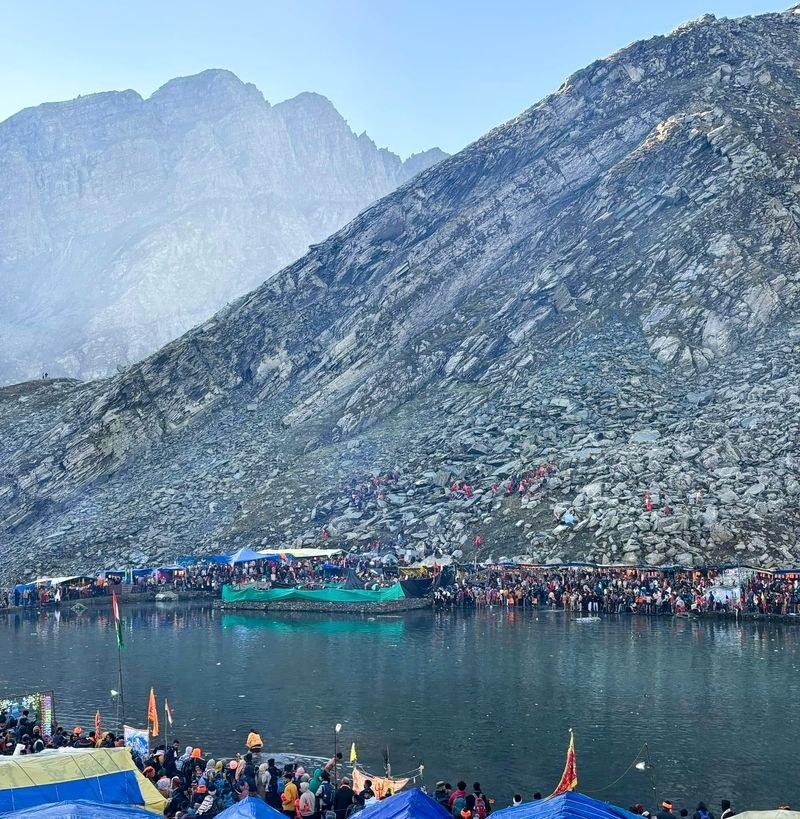
Held every year during August and September in the tribal Bharmour region of Chamba district, the pilgrimage attracts lakhs of devotees from across the country who undertake the arduous trek to the sacred Manimahesh lake, located at an altitude of nearly 13,500 feet beneath the Manimahesh Kailash peak, believed to be the abode of Lord Shiva.
This year, the yatra will commence on September 4 on the occasion of Janmashtami and conclude on September 19 coinciding with Radhashtami. The pilgrimage route begins from Hadsar and passes through Dhancho, Sundrasi and Gaurikund before reaching the holy lake.
With increasing concern over waste accumulation, overcrowding and ecological degradation in the sensitive Himalayan region, the local administration has decided to enforce tighter environmental norms along the route. Bharmour Additional District Magistrate Vikas Sharma recently held consultations with stakeholders, including priests and shopkeepers, to discuss implementation of the new measures.
The NGT, in its 2024 directions, had recommended mandatory online registration of pilgrims, assessment of the trekking route’s carrying capacity and regulation of daily pilgrim movement to reduce environmental pressure on the area.
Authorities are also planning strict monitoring of commercial activities during the pilgrimage. No shops or langars will be permitted within the catchment area of the sacred Manimahesh Dal in an effort to preserve water quality and maintain the sanctity of the site. Last year, forest authorities had removed several unauthorised shops set up near the lake.
Officials said temporary stalls along the Hadsar-Manimahesh route would be allowed to function only after obtaining permission from the Forest Department and paying sanitation charges for waste collection and disposal.
The administration has warned that plastic littering, illegal encroachments and unauthorised commercial activity will invite strict action during the pilgrimage season.
An eco-fee and sanitation charge for pilgrims and commercial establishments are also under consideration to support waste management, trail maintenance and environmental conservation initiatives along the route.
Alongside environmental safeguards, the administration has accelerated restoration and safety works on the yatra track, portions of which suffered extensive damage during heavy rains and landslides last year. Repair work on the trekking route from Hadsar to Manimahesh Dal is already underway.
Authorities have also instructed departments concerned to restore vulnerable stretches of the Bharmour-Hadsar road damaged during the monsoon. To improve pilgrim safety, new wooden bridges will be constructed at sensitive locations such as Dunali and Dhancho where earlier structures were either washed away or badly damaged.
The administration hopes the measures will help strike a balance between facilitating the centuries-old pilgrimage and preserving the ecologically fragile Himalayan landscape through which it passes.
The Baisakhi Sale Plan offers an excellent value of 2 years of subscription + 6 months complimentary.
If you proceed with this purchase, your current monthly subscription plan will be immediately cancelled.