
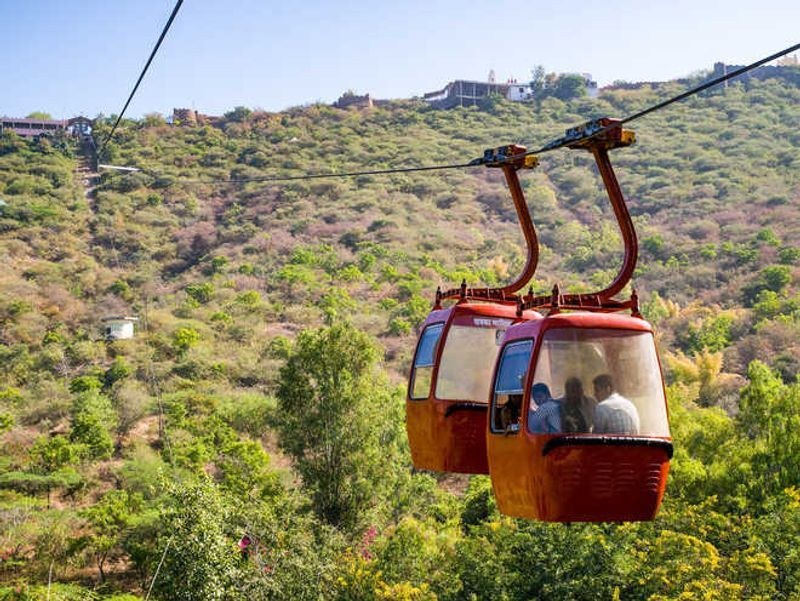
The ropeway project, proposed to be developed under the public-private partnership (PPP) model, is awaiting final cabinet approval. Deputy Chief Minister Mukesh Agnihotri, who holds the Transport portfolio, has sought clearance from the Finance Department before the proposal is placed before the Cabinet, indicating financial viability concerns at the highest level.
Officials say the project has reached an advanced stage procedurally, with even the Union Finance Ministry’s Department of Economic Affairs granting permission to proceed despite receiving a single bid — from an Austrian firm — for its execution. However, the state’s constrained fiscal position is proving to be a stumbling block.
Under the 80:20 funding pattern, Himachal Pradesh is required to contribute 20 per cent of the project cost. This share has already risen from Rs 388 crore to Rs 540 crore due to cost escalation. While the government is exploring funding options, including securing 80 per cent of the financing from the New Development Bank, mobilising its own contribution remains difficult amid an ongoing financial strain.
The project, which has been in the pipeline for over a decade, gained momentum only after forest clearance for around six hectares was granted in October 2025. Despite this critical approval, repeated revisions in cost estimates have complicated its rollout timeline.
Originally pegged at Rs 1,556 crore, the cost rose to Rs 2,100 crore last year before touching nearly Rs 3,000 crore now, almost doubling within a span of three years. This sharp escalation is being attributed to delays, inflationary pressures and evolving technical specifications.
Designed to significantly ease congestion in Shimla, particularly during peak tourist seasons and rush hours, the 13.65-km ropeway is expected to be one of the largest aerial urban transport systems globally. It aims to reduce dependence on road-based transport in the densely built hill city, where expansion of road infrastructure is inherently constrained.
The government remains keen to push the project forward, given the mounting pressure to address traffic bottlenecks that disrupt daily life and tourism alike. However, with limited fiscal headroom and competing expenditure priorities, officials concede that financial closure could take time.
Unless the state is able to firm up its funding plan soon, the execution of the much-anticipated ropeway project may face further delays, prolonging Shimla’s struggle with gridlocked roads and unplanned urban mobility.
Stations (13): Tara Devi, Tutikandi, ISBT, Victory Tunnel, Railway Station, Secretariat, Sanjauli, IGMC, Ice Skating Rink and more
Objective: Decongest Shimla’s roads and provide sustainable urban mobility
The Baisakhi Sale Plan offers an excellent value of 2 years of subscription + 6 months complimentary.
If you proceed with this purchase, your current monthly subscription plan will be immediately cancelled.
30?"green-strip-scroll":""}">n ${e.display_status||e.scheduleTime}n
30?"green-strip-scroll":""}">n ${e.display_status+", "+e.scheduleTime}n
n n n n n n n n n n n n n ',e.addEventListener("click",(function(){gtag("event","go_premium_banner_click",{cta_text:"Go Premium Banner"})})),A.appendChild(e),C.insertAdjacentElement("afterend",A)}})):setTimeout(i,300)}function A(C){C.matches?setTimeout(i,500):document.querySelectorAll(".goPremiumWrapper").forEach((C=>C.remove()))}A(C),C.addEventListener("change",A)}()var isLiveBlog=!1,slug="shimla-ropeway-faces-funding-hurdle-as-costs-nearly-double",post_title="Shimla ropeway faces funding hurdle as costs nearly double",enable_highlighter=!1,pwa_infinitescroll_enabled=!1,analytics_id="",app_name="The Tribune",gallery="",widgets_inbtw=!0,widgets_related=!0,widgets_trnding=!1,widgets_wp_webstories=!1,postId="2532639",post_image_medium="https://www.tribuneindia.com/sortd-service/imaginary/v22-01/jpg/medium/high?url=dGhldHJpYnVuZS1zb3J0ZC1wcm8tcHJvZC1zb3J0ZC9tZWRpYTYyNzMzNDEwLTNjY2YtMTFmMS1hMjhiLThiZWUzODg3Y2VjMC5qcGc=",audio_content=" The ambitious Shimla Ropeway and Rapid Transport System, envisioned as a long-term solution to the hill town’s chronic traffic congestion, is facing fresh uncertainty as the Himachal Pradesh Government grapples with a severe resource crunch. With the project cost escalating sharply from Rs 1,556 crore in 2022 to nearly Rs 2,980 crore now, arranging the state’s revised share of Rs 540 crore has emerged as a major challenge. The ropeway project, proposed to be developed under the public-private partnership (PPP) model, is awaiting final cabinet approval. Deputy Chief Minister Mukesh Agnihotri, who holds the Transport portfolio, has sought clearance from the Finance Department before the proposal is placed before the Cabinet, indicating financial viability concerns at the highest level. Officials say the project has reached an advanced stage procedurally, with even the Union Finance Ministry’s Department of Economic Affairs granting permission to proceed despite receiving a single bid — from an Austrian firm — for its execution. However, the state’s constrained fiscal position is proving to be a stumbling block. Under the 80:20 funding pattern, Himachal Pradesh is required to contribute 20 per cent of the project cost. This share has already risen from Rs 388 crore to Rs 540 crore due to cost escalation. While the government is exploring funding options, including securing 80 per cent of the financing from the New Development Bank, mobilising its own contribution remains difficult amid an ongoing financial strain. The project, which has been in the pipeline for over a decade, gained momentum only after forest clearance for around six hectares was granted in October 2025. Despite this critical approval, repeated revisions in cost estimates have complicated its rollout timeline. Originally pegged at Rs 1,556 crore, the cost rose to Rs 2,100 crore last year before touching nearly Rs 3,000 crore now, almost doubling within a span of three years. This sharp escalation is being attributed to delays, inflationary pressures and evolving technical specifications. Designed to significantly ease congestion in Shimla, particularly during peak tourist seasons and rush hours, the 13.65-km ropeway is expected to be one of the largest aerial urban transport systems globally. It aims to reduce dependence on road-based transport in the densely built hill city, where expansion of road infrastructure is inherently constrained. The government remains keen to push the project forward, given the mounting pressure to address traffic bottlenecks that disrupt daily life and tourism alike. However, with limited fiscal headroom and competing expenditure priorities, officials concede that financial closure could take time. Unless the state is able to firm up its funding plan soon, the execution of the much-anticipated ropeway project may face further delays, prolonging Shimla’s struggle with gridlocked roads and unplanned urban mobility. A ride above the rush Length: 13.65 km aerial ropeway network Scale: Among the world’s largest urban ropeway systems Capacity: 3,000 passengers per hour per direction Technology: Mono-cable detachable gondola system Cabins: 660 cabins, 10 passengers each Frequency: One cabin every 2–3 minutes Stations (13): Tara Devi, Tutikandi, ISBT, Victory Tunnel, Railway Station, Secretariat, Sanjauli, IGMC, Ice Skating Rink and more Objective: Decongest Shimla’s roads and provide sustainable urban mobility ",article_price=0,theme_color="#0d1c3d",is_article_paid=!1,is_paid_article_enabled=!1;if(widgets_inbtw)var inbtw_count=1,category_id=48,inbtw_label="Read More",inbtw_color="",inbtw_layout="inBtwPostsCarousal";if(widgets_trnding)var trnd_layout="",trnd_cardName="",trnd_count=5;if(widgets_wp_webstories)var wp_ws_layout="",wp_ws_cardName="",wp_ws_text_color="",wp_ws_background="",wp_ws_custom_css="";if(widgets_trnding){theme_color="#0d1c3d";var article_color="",status=!0;function getTrendingArticles(e,t,a,i=!1){a||(a="Trending Now");let r="";r+=`${a}`,r+='';let n=e.length>t?t:e.length;for(let t=0;t