
Key Highlights
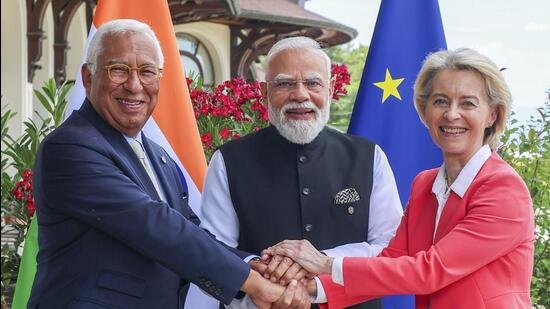
- PM Modi met EU leaders on the sidelines of G7 Summit in Evian, France.
- Both sides emphasized early signing and implementation of the India-EU Free Trade Agreement.
- The FTA is expected to be signed by the end of 2026.
- Leaders also discussed defence, security, investment, and global issues.
India and EU Push for Early Signing of Free Trade Deal
India and the European Union on Wednesday underscored the need to expedite the signing and implementation of a free trade agreement (FTA) as Prime Minister Narendra Modi met top EU leaders on the margins of the G7 Summit in Evian, France. The meeting, held less than five months after the conclusion of FTA negotiations, focused on deepening economic linkages and enhancing cooperation in defence, security, and shaping a resilient multipolar global order.
Prime Minister Modi met European Council President António Costa and European Commission President Ursula von der Leyen in the French resort town of Evian. The leaders had earlier finalized a comprehensive strategic agenda during a visit to New Delhi in January 2026.
What Leaders Said
“This has been a great time for India-EU ties as we have concluded the Free Trade Agreement,” PM Modi said on social media, referring to the EU leaders’ participation in India’s Republic Day celebrations earlier this year. “During our talks, we discussed how to further deepen economic linkages in the times to come. Our growing cooperation can play an important role in strengthening peace, stability and prosperity in today’s global environment,” he added.
Costa and von der Leyen stated in identical social media posts that India and the EU “have been moving fast to deliver on our commitments” after concluding the “mother of all trade deals.” They confirmed that the two sides will sign the FTA by the end of the year, accelerate work on an investment agreement, step up security and defence cooperation, and advance the India-Middle-East-Europe Economic Corridor (IMEC).
Details of the Agreement
The external affairs ministry described the conclusion of FTA negotiations as a “historic achievement” and stressed the need for expeditious signing and implementation to unlock trade and investment opportunities and diversify supply chains amid geopolitical turbulence. The leaders also reviewed progress on the India-EU Comprehensive Strategic Agenda finalized in January and discussed regional and global issues, including developments in West Asia and the Russia-Ukraine conflict.
Modi’s Bilateral Meeting with German Chancellor
On the sidelines of the G7 Summit, PM Modi also held a bilateral meeting with German Chancellor Friedrich Merz. The two leaders reviewed bilateral ties and agreed to strengthen cooperation in trade, investment, defence, security, technology, sustainable development, education, and mobility. They welcomed the signing of the defence industrial cooperation roadmap and the operationalisation of a transit visa waiver for Indian nationals.
Modi described his talks with Merz as fruitful, stating on social media: “We discussed ways to further cement bilateral cooperation by working together in trade, investments, circular economy, defence, IT and more.” The leaders also discussed the Russia-Ukraine conflict and welcomed the understanding reached to end the conflict in West Asia. Merz invited Modi to Germany for inter-governmental consultations later this year.
FAQ
What is the India-EU Free Trade Agreement?
The India-EU FTA is a proposed trade deal aimed at reducing tariffs and boosting economic cooperation between India and the European Union.
When will the India-EU FTA be signed?
Both sides have agreed to sign the agreement by the end of 2026.
What other areas of cooperation were discussed at the G7 Summit?
Leaders discussed defence and security, investment, connectivity projects like IMEC, and global issues such as the Russia-Ukraine conflict and West Asia peace.