
Overview of NCR Regional Plan 2041
After a delay of nearly five years, the National Capital Region Planning Board (NCRPB) cleared the Regional Plan 2041 on Tuesday, setting the direction for development across 55,083 sq km encompassing Delhi and parts of Haryana, Uttar Pradesh, and Rajasthan. The plan, chaired by Union Housing and Urban Affairs Minister Manohar Lal Khattar, will shape urban growth, transport networks, pollution control, and environmental conservation for the next two decades.
The plan will be finalized by a sub-committee of senior officials from the Union government and NCR states, with a report due by August 15. It will then be submitted to the Union Ministry of Housing and Urban Affairs for formal approval.
Key Features of the Regional Plan 2041
No Change in NCR Boundaries, But Three Pollution Zones
One of the major disputes—whether to remove certain Haryana districts from NCR—was resolved with no boundary changes. However, the board approved dividing NCR into three zones for environmental regulations. The core area is defined by the Kundli-Ghaziabad-Palwal and Kundli-Manesar-Palwal expressway networks. The remaining districts fall into two additional categories, with restrictions calibrated to their distance from the core. This aims to ease the burden on districts farther from Delhi, such as Karnal, Jind, Mahendragarh, Bhiwani, and Charkhi Dadri, which had sought relief from winter construction bans.
Four New 'Namo' Cities Along RRTS Corridors
The plan proposes four greenfield cities along Regional Rapid Transit System (RRTS) corridors to absorb future population growth. These cities, tentatively named with the prefix 'Namo', are planned in Jewar and Dadri (Uttar Pradesh), Bharatpur (Rajasthan), and Kundli (Haryana). A fund of ₹5,000 crore over five years has been discussed for these cities and environmental initiatives.
New Expressways and Orbital Railway
Two new regional expressways are proposed: one linking Panipat, Meerut, Hapur, Rewari, and Rohtak; another connecting Karnal, Muzaffarnagar, Aligarh, Mathura, and Alwar. An orbital railway in Uttar Pradesh, similar to one already approved in Haryana, is also expected.
Vehicle Replacement Scheme 'Parivartan'
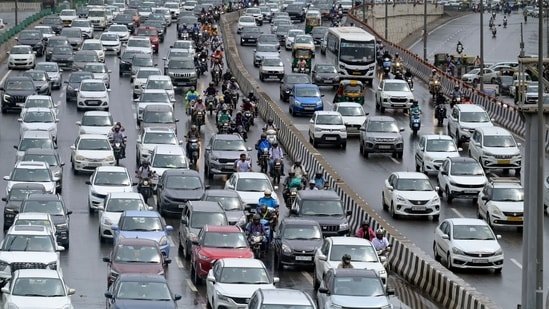
To tackle vehicular pollution, which accounts for nearly 40% of NCR's emissions, the board reviewed the Parivartan scheme aimed at replacing older vehicles with BS-VI-compliant ones.
Water Management Focus
The plan emphasizes wastewater recycling and groundwater recharge. Khattar stressed, "It should not run out; it should be processed and reused."
Aravalli Conservation Concerns
Conservation of the Aravalli hills remains contentious. Khattar assured that there will be no change to existing orders from the NGT, Supreme Court, or Union environment ministry. However, ground verification of forest land is incomplete, and experts note that the plan lacks explicit protections for the Aravallis, leaving scope for encroachments and mining.
Population Projections and Urbanization
According to the 2011 Census, NCR's population was 5.81 crore. The draft RP-2041 projects 7 crore by 2031 and 11 crore by 2041, with 67% urban population. Khattar estimated the current population at 7 crore, expected to reach nearly 15 crore in 15 years.
What This Means for Residents
The plan aims to decongest Delhi by promoting polycentric growth, improving connectivity, and balancing environmental regulations. Residents in peripheral districts may see relaxed pollution norms, while new cities and expressways could boost economic opportunities. However, the effectiveness of Aravalli conservation measures remains to be seen.
Frequently Asked Questions
- What is NCR Regional Plan 2041? It is a long-term blueprint for land use, infrastructure, housing, transport, and environmental protection across the National Capital Region, covering Delhi and parts of Haryana, Uttar Pradesh, and Rajasthan.
- How many new cities are proposed under RP-2041? Four greenfield cities, tentatively named 'Namo' cities, are proposed along RRTS corridors in Jewar, Dadri (UP), Bharatpur (Rajasthan), and Kundli (Haryana).
- What are the three pollution zones in NCR? The core area is defined by the Kundli-Ghaziabad-Palwal and Kundli-Manesar-Palwal expressways. The remaining districts are divided into two additional zones with calibrated restrictions based on distance from the core.
- Will NCR boundaries change? No, the existing boundaries remain unchanged. However, a three-zone system for environmental regulations has been introduced to ease restrictions for distant districts.