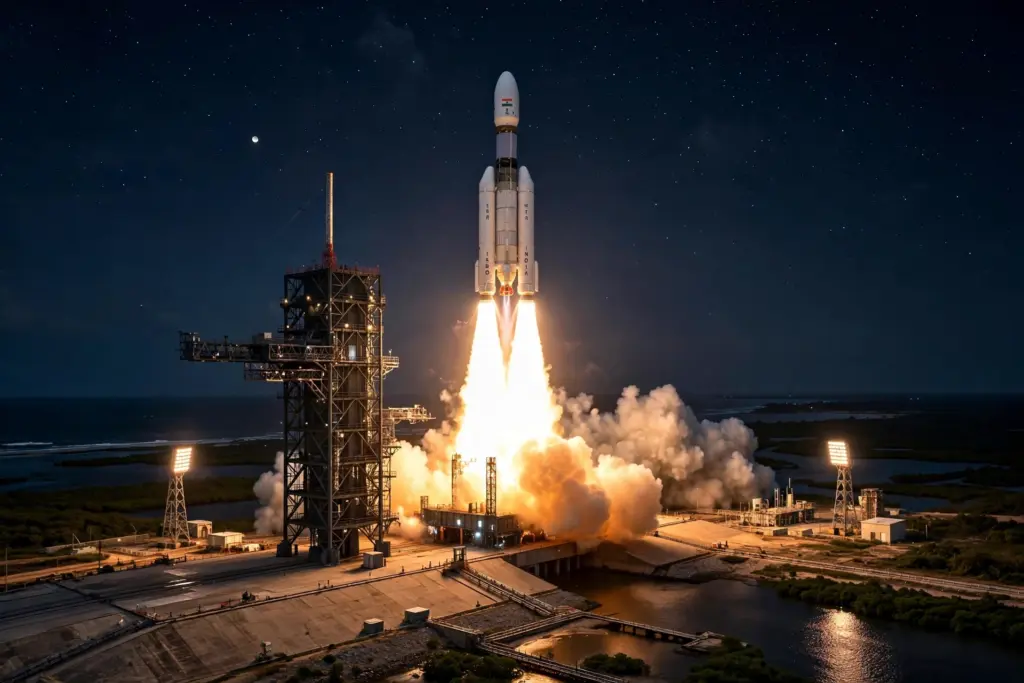
The Indian Space Research Organisation (ISRO) has successfully launched the NVS-03 navigation satellite aboard the GSLV-F18 rocket, restoring India’s home-grown NavIC navigation system to its minimum working strength of four satellites.
The launch
- Launch date: 30 October 2026, at 11:51 PM from the Second Launch Pad at Satish Dhawan Space Centre, Sriharikota
- Rocket: GSLV-F18 — the 20th flight of India’s Geosynchronous Satellite Launch Vehicle
- Satellite: NVS-03, weighing 2,250 kg, was placed precisely into its intended Geosynchronous Transfer Orbit after a flight of about 18 minutes and 40 seconds
- It was only the second successful launch of 2026 for ISRO, after two PSLV failures in the previous 18 months
Why NVS-03 matters
NavIC — Navigation with Indian Constellation — is India’s own satellite navigation system, used for location services in phones and vehicles, aviation, maritime navigation, disaster management and border security. The system had been running short of satellites for at least six months after the NVS-02 satellite failed to reach its intended orbit in January 2025, and one of the older satellites lost its last atomic clock in March 2026.
NVS-03 carries India’s third home-grown atomic clock and restores the constellation to four working satellites. ISRO Chairman Dr V. Narayanan said the next-generation satellites NVS-04 and NVS-05 are expected to launch within about 10 months.
What comes next
ISRO is preparing for five more launches before the end of the financial year, including the first uncrewed Gaganyaan mission (G1), two PSLV missions, a small satellite mission and a private launch. The GSLV-F18 mission was also completed on a shorter schedule than usual — the launch campaign took 47 days, and the gap from the previous GSLV mission was just 56 days.
Related articles on HimachalGovt
- Tiger Triumph 2026: India-US Tri-Service Exercise Begins in Visakhapatnam — https://himachalgovt.com/stories/tiger-triumph-2026-india-us-exercise-visakhapatnam
- INS Sahyadri Completes India-South Korea Naval Exercise off Busan — https://himachalgovt.com/stories/ins-sahyadri-completes-india-south-korea-naval-exercise-busan
- India Extends $500 Million Line of Credit to Guyana for Roads, Health and Defence — https://himachalgovt.com/stories/india-extends-500-million-line-of-credit-guyana