After Diwali on Sunday 8 November, the festival continues with two more days that many families treat as just as important as Diwali itself. Govardhan Puja falls on Tuesday, 10 November 2026, and Bhai Dooj falls on Wednesday, 11 November 2026. Both dates come from Drik Panchang for New Delhi, and both have a morning or afternoon muhurat that is easy to plan around.
One thing to note this year: Monday 9 November has no major festival in most of India. That is because Amavasya runs until 12:31 PM on 9 November, and the next tithi, Pratipada, only prevails at sunrise on 10 November. Some printed calendars list Govardhan Puja on 9 November, but most panchangs that follow the sunrise (udaya tithi) rule place it on 10 November. If your family follows a particular calendar or your local temple has announced a date, go with that.
Govardhan Puja — Tuesday, 10 November 2026
- Pratipada Tithi: 12:31 PM on 9 November to 2:00 PM on 10 November
- Govardhan Puja morning muhurat: 6:40 AM to 8:50 AM, New Delhi
- Also known as: Annakut, Bali Pratipada, Padwa
- Gujarati New Year (Bestu Varas): also 10 November
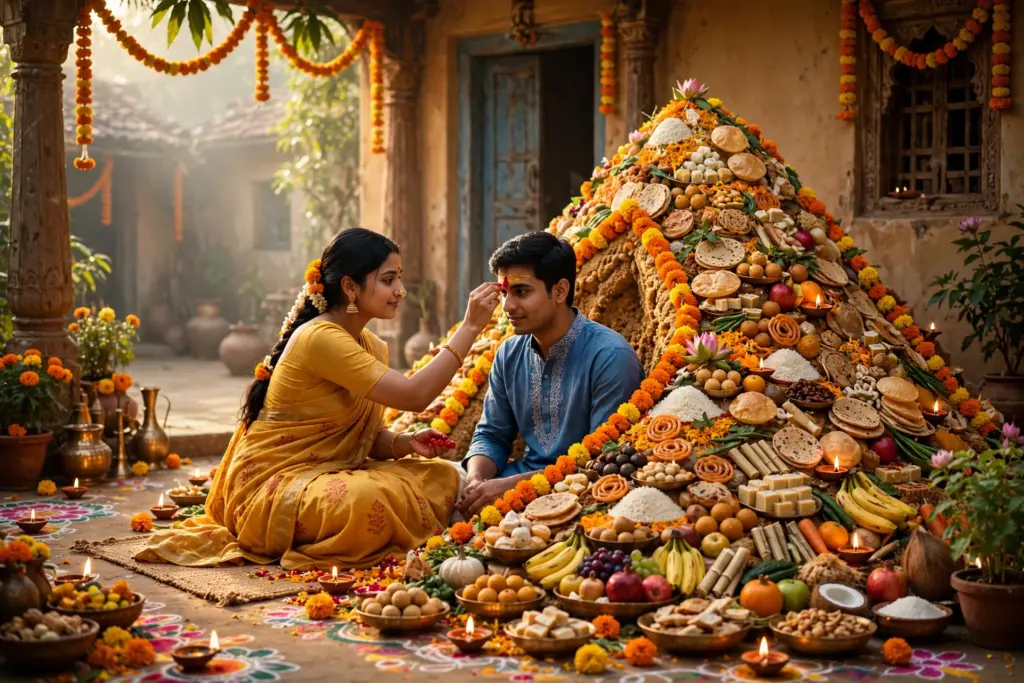
Govardhan Puja celebrates the story of Lord Krishna lifting the Govardhan hill to protect the people of Vrindavan from the storms sent by Lord Indra. In the morning, families make a small hill of cow dung or mud in the courtyard to represent Govardhan, decorate it with flowers, and worship it with milk, curd and sweets. In temples and many homes, the Annakut — a mountain of food — is offered to Krishna: dozens of dishes, from rice and dal to sweets, are laid out in front of the deity and later shared as prasad.
In Maharashtra the day is kept as Bali Padva, remembering King Bali, and in Gujarat it is the New Year, when businesses open new account books and people greet each other with “Saal Mubarak”. Cows and bullocks are also worshipped on this day in many villages, because the festival is at heart a thanksgiving to nature and to the animals that support farming.
Bhai Dooj — Wednesday, 11 November 2026
- Dwitiya Tithi: 2:00 PM on 10 November to 3:53 PM on 11 November
- Bhai Dooj tilak muhurat (Aparahna): 1:10 PM to 3:20 PM, New Delhi
- Also known as: Bhaiya Dooj, Bhau Beej, Yama Dwitiya
Bhai Dooj is the festival of the bond between brothers and sisters. The legend is that Yamuna invited her brother Yama, the god of death, to her home, applied a tilak on his forehead and prayed for his long life — and Yama blessed every brother whose sister applies a tilak on this day. On Bhai Dooj, sisters apply a tilak on their brothers’ foreheads, pray for their long life and well-being, and brothers give gifts in return. The day is kept across North India, and in Maharashtra it is called Bhau Beej.
The tilak is done in the afternoon, in the Aparahna period, which is why the muhurat is 1:10 PM to 3:20 PM. Sisters usually prepare a plate with a diya, roli, rice, flowers and sweets, and the brother sits facing east or north for the tilak. Many families combine it with a meal together, and brothers who live in another city often video-call for the tilak.
The full Diwali week at a glance
- Friday, 6 November: Dhanteras — gold and silver buying
- Sunday, 8 November: Narak Chaturdashi (Choti Diwali) in the morning, Diwali and Lakshmi Puja in the evening (muhurat 5:54 PM to 7:50 PM, New Delhi)
- Monday, 9 November: no major observance in most of India
- Tuesday, 10 November: Govardhan Puja and Annakut (morning muhurat 6:40 AM to 8:50 AM), Gujarati New Year
- Wednesday, 11 November: Bhai Dooj (tilak muhurat 1:10 PM to 3:20 PM)
- 13 to 16 November: Chhath Puja, with Sandhya Arghya on 15 November and Usha Arghya on 16 November
Banks, travel and practical notes
Banks are closed on 9, 10 and 11 November in most states for the Diwali week, so plan any branch work around those days. If you are travelling for Bhai Dooj, trains and buses are crowded through the week — Indian Railways is running Diwali and Chhath special trains, and Tatkal booking is the main option left on busy routes. In Delhi, the green-cracker rules apply only on 7 and 8 November; a full ban on bursting resumes from 9 November, so Govardhan Puja and Bhai Dooj are cracker-free days in the capital.
Related articles on HimachalGovt
- Dhanteras 2026 Today: Puja Muhurat 6:02 PM to 7:57 PM, Gold Buying Timings and What to Buy — https://himachalgovt.com/stories/dhanteras-2026-date-puja-muhurat-gold-buying-guide
- Chhath Puja 2026: Dates 13 to 16 November, Arghya Timings and Four-Day Ritual — https://himachalgovt.com/stories/chhath-puja-2026-dates-arghya-timings-13-16-november
- Bank Holidays November 2026: Diwali Closures on 9, 10 and 11 November, Full List — https://himachalgovt.com/stories/bank-holidays-november-2026-diwali-full-list