India will never open its dairy sector to foreign competition and will never allow imports of genetically modified (GM) products, Commerce and Industry Minister Piyush Goyal said on Tuesday, 3 November 2026. Speaking to students at the Young Leaders Discourse Forum at Kirori Mal College, Delhi University, Goyal said India has “never ever” compromised on sensitive items in any trade agreement, and dairy and GM products will stay off the table in every free trade agreement (FTA) India signs in future.
The statement matters because dairy and GM farm products are among the biggest sticking points in India’s trade talks with the United States and other large farm-exporting countries. The US has repeatedly pressed India to open its dairy market and to accept GM crops. Goyal’s answer was a clear no — and he framed it as a permanent red line, not a bargaining position.
What Goyal actually said
- “We are very sensitive to opening our dairy. In fact, till date, we have never opened up dairy for anybody,” Goyal told the students.
- “We are very sensitive not to allow any GM products to come to India and we have never allowed it and we’ll never allow it in the future.”
- He said India has never given any duty concessions in the dairy sector in any FTA it has signed so far.
- He added that protecting farmers, fishermen and micro, small and medium enterprises (MSMEs) “has always been a consistent feature of India’s trade agreements”.
Why dairy is a red line for India
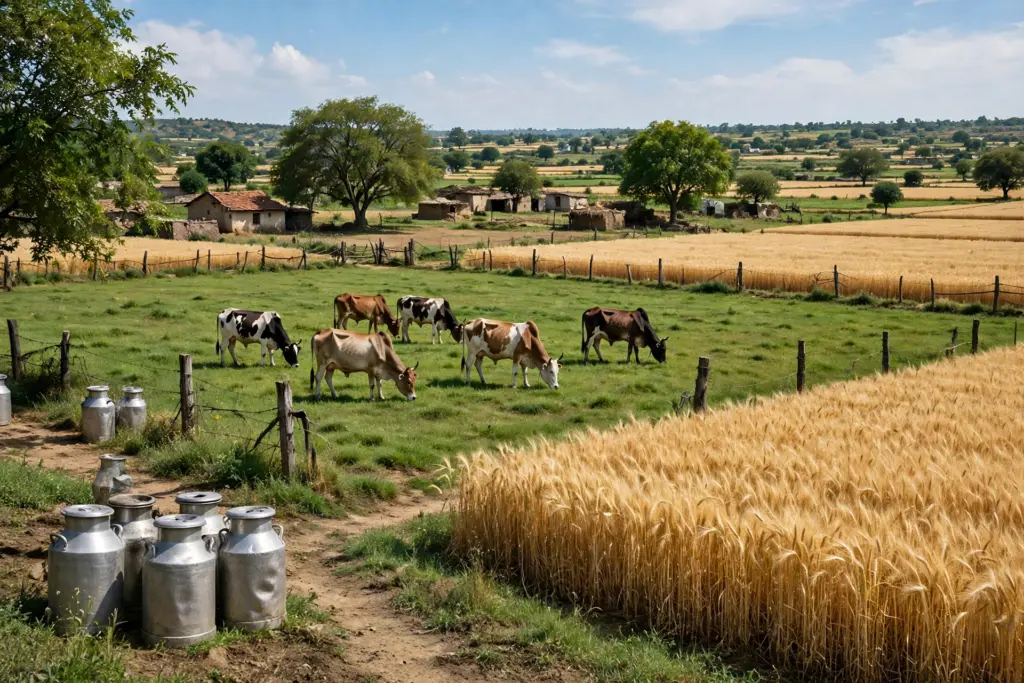
India is the world’s largest milk producer, and its dairy sector is built on more than 80 million small farmers, most of whom keep only a few animals. Cheap imports of milk powder, butter and cheese from large, mechanised and heavily subsidised dairy industries abroad could push down prices at home and hit the incomes of those small farmers. That is the economic reason for the protection.
There is also a cultural reason, and Goyal spoke about it directly. In many foreign countries, cheese is made using calf rennet — an enzyme taken from the stomach lining of young calves — and cattle are often fed feed that contains animal-derived material. Indian rules do not allow that. The Food Safety and Standards Authority of India (FSSAI) requires imported milk and dairy products to carry certification that they come only from cows and buffaloes raised on a vegetarian diet and never fed mammalian tissues. Goyal said India is “sensitive to our religious sensitivities” and that imported dairy must be certified so that “religious sensitivities of the large parts of India are not hurt”.
The same thinking applies to marine products, another sector Goyal named as sensitive, because opening it up would hurt artisanal fishing communities along India’s coasts.
Why GM products are also blocked
India has never permitted imports of GM food products, and Goyal said that will not change. Policymakers worry that low-cost GM crop imports from developed countries, where farming is highly mechanised and subsidised, could depress domestic prices and hurt rural incomes. There is also the question of food safety regulation and consumer acceptance at home, where GM food remains a sensitive subject.
The US has major commercial interests in both GM farm products and dairy, so this red line directly affects the India-US trade talks. Goyal’s message was that India will keep talking, but not on these items.
What India wants instead
Goyal was clear that India is not closing itself off from trade. He said India’s “offensive interests” — the sectors where it wants better access to foreign markets — are textiles, pharmaceuticals, agricultural products, and gems and jewellery. In trade pacts, India seeks lower duties for its goods than the duties charged on goods from competing countries such as Indonesia, Malaysia, Vietnam, China and the Philippines.
That fits with India’s wider export push. India is targeting $1 trillion in annual exports, after exports grew 14% to $480 billion in the first half of the financial year. Goyal’s argument is that India can chase that target through its strong sectors without giving away its sensitive ones.
What it means for farmers and consumers
- For dairy farmers: no change. The protection that keeps foreign milk powder and cheese out of the Indian market at concessional duties stays in place.
- For consumers: dairy products on Indian shelves will continue to follow Indian rules on vegetarian feed and non-animal rennet certification.
- For trade talks: partners who want dairy or GM access will have to look elsewhere in the deal. That could slow down some negotiations, because trading partners often push for broader access to India’s large consumer market in exchange for the access India wants for textiles, pharma and gems.
- For the India-US talks specifically: dairy and GM remain the hardest items on the table, and Goyal’s statement signals that India will not move on them even if it means a slower deal.
What happens next
There is no new trade agreement being signed on the back of this speech — Goyal was stating policy at a student forum, not announcing a deal. The practical effect is on the negotiations that are already running: India’s negotiators now have a public, minister-level statement to point to when partners raise dairy or GM access. Watch for the next round of India-US trade talks and for the FTAs India is negotiating with other partners, where the same red lines will apply.