Category: News
Three of India’s oldest works have received fresh international recognition. The manuscripts of Kalhana’s Rajatarangini, the Mahabharata and Kautilya’s Arthashastra have been included in UNESCO’s Memory of the World Asia-Pacific Regional Register.
The decision was taken at the 11th session of the Memory of the World Committee for Asia and the Pacific (MOWCAP), held in Jakarta, Indonesia, and announced on 5 November 2026. The Indira Gandhi National Centre for the Arts (IGNCA) prepared the nomination dossiers for all three manuscripts, and its member secretary, Sachchidanand Joshi, announced the decision. Union Culture Minister Gajendra Singh Shekhawat welcomed the recognition.
With these three additions, India’s total in the Asia-Pacific Regional Register has risen to six. India had secured three entries in the regional register in 2024. The latest round added 21 new inscriptions to the regional register for the 2025-2026 nomination cycle.
The three works
Kalhana’s Rajatarangini — written in 12th-century Kashmir, it is one of South Asia’s earliest systematic works of history, tracing the dynasties of the Kashmir Valley. Its manuscript is preserved at the Oriental Research Library in the Sri Pratap Singh Library Complex in Srinagar.
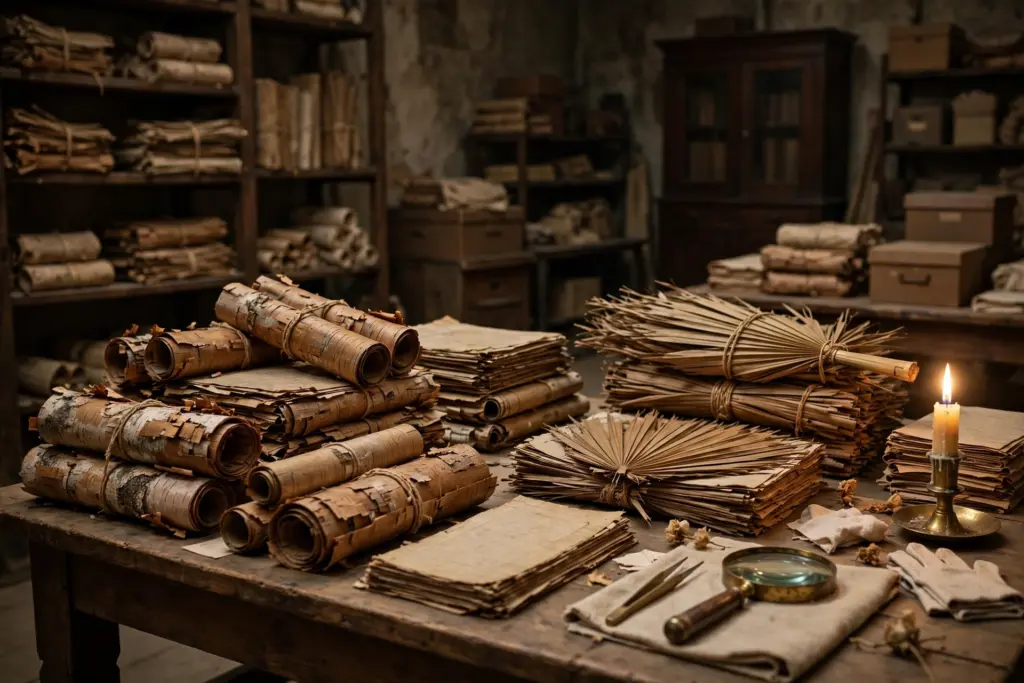
The Mahabharata — the recognised manuscript is a birch-bark document written in the Sharada script, about 400 years old, preserving the older Kashmiri recension of the epic. It is one of the foundational texts of Indian moral and philosophical thought.
Kautilya’s Arthashastra — a foundational Sanskrit treatise on governance, economics, administration, diplomacy and military strategy, written by the scholar also known as Chanakya. The manuscript included in the register is a 16th-century palm-leaf copy written in the Grantha script, preserved at the Oriental Research Institute in Mysuru, Karnataka.
Together, the three works cover dharma, history and statecraft — the three pillars of classical Indian thought.
What the register means
UNESCO’s Memory of the World Programme was set up in 1992 to safeguard documentary heritage such as manuscripts, archives and audiovisual records. The Asia-Pacific Regional Register recognises documentary heritage of outstanding value within the region, while the separate International Register covers heritage of global significance.
India has 13 entries on the International Register, including the Rig Veda, inscribed in 2005, and the Bhagavad Gita and the Natyashastra, added in 2025 among 74 new entries that year. The latest additions are to the regional register, not the international one.
The recognition does not change who owns or holds the manuscripts. It records their value as documentary heritage and supports their preservation, study and wider awareness.
Sources: Indrajit Global News, Trends News Stories, Manorama Yearbook, Insights on India and Nation Press, 5-6 November 2026.