Category: News
The Indian Space Research Organisation (ISRO) has completed a key test for the Gaganyaan human spaceflight programme. On 16 October 2026, ISRO announced that it had successfully completed a series of Crew Module–Service Module separation tests at the Vikram Sarabhai Space Centre (VSSC) in Thiruvananthapuram.
The tests were carried out on a full-scale, heavily instrumented assembly of the two modules. The separation sequence included severing the umbilical connections that link the modules, using pyrotechnic devices. The tests validated the design of the separation system and showed that several Crew Module subsystems — including avionics, inertial navigation, thermal protection, the deployable umbilical shield and the pyrotechnic devices — can withstand the shock of separation.
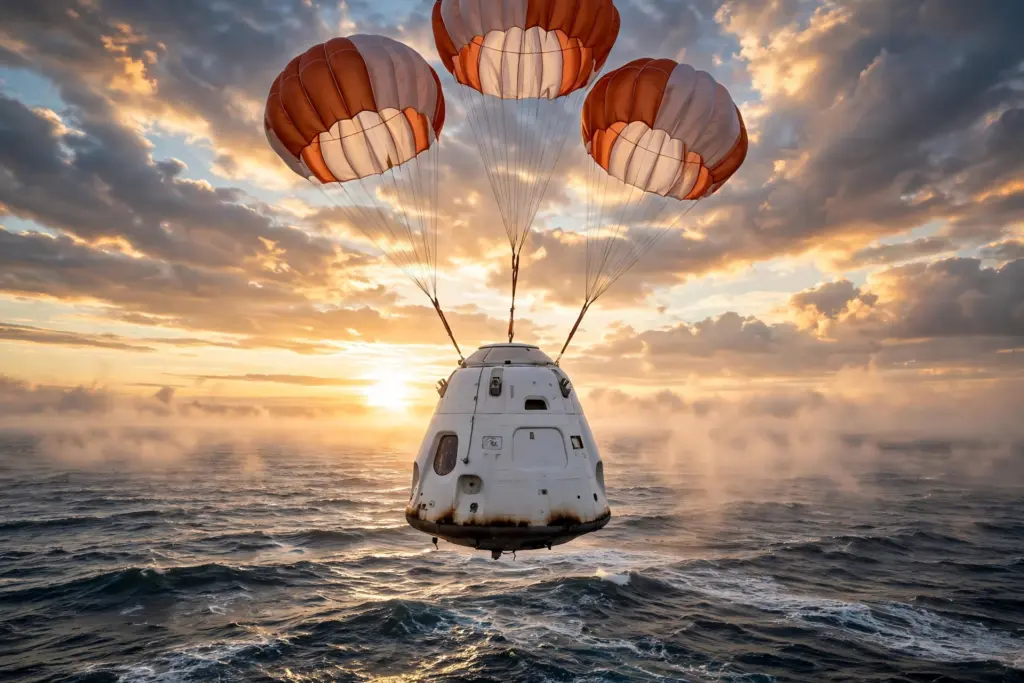
The separation is one of the mission’s most decisive moments: before re-entering the atmosphere, the Crew Module must release the Service Module, which supplies electricity and fluids through the umbilical lines, and travel alone for descent.
When will G1 fly?
G1 is the first of three uncrewed orbital flights before the crewed mission, and it is targeted for the fourth quarter of 2026. ISRO Chairman V. Narayanan said on 24 October 2026 that G1 would fly “in two months” from Sriharikota — pointing to around late December 2026.
No launch date has been announced. December is a target, not a date — and Gaganyaan’s history is a history of slipped quarters, so the window is not guaranteed.
G1 will carry Vyommitra, a half-humanoid robot built to simulate crew functions, instead of astronauts, on the human-rated LVM3 rocket. It will fly to low Earth orbit and return for recovery.
What is still pending
Before G1 flies, ISRO still has to complete the TV-D2 abort-system flight test, finish the final integration of Vyommitra into the Crew Module, and confirm a launch date. Milestones already cleared in 2026 include an air-drop parachute test in April 2026.
The first crewed Gaganyaan mission is targeted for 2027, after G1 and two more uncrewed flights. It aims to carry three astronauts to an orbit of about 400 km for up to three days, and bring them back safely for splashdown in Indian waters.
Sources: ISRO, 16 October 2026; thespaceroad, 3 November 2026; spacecraftindia, 17 October 2026; Swarajya, 17 October 2026.