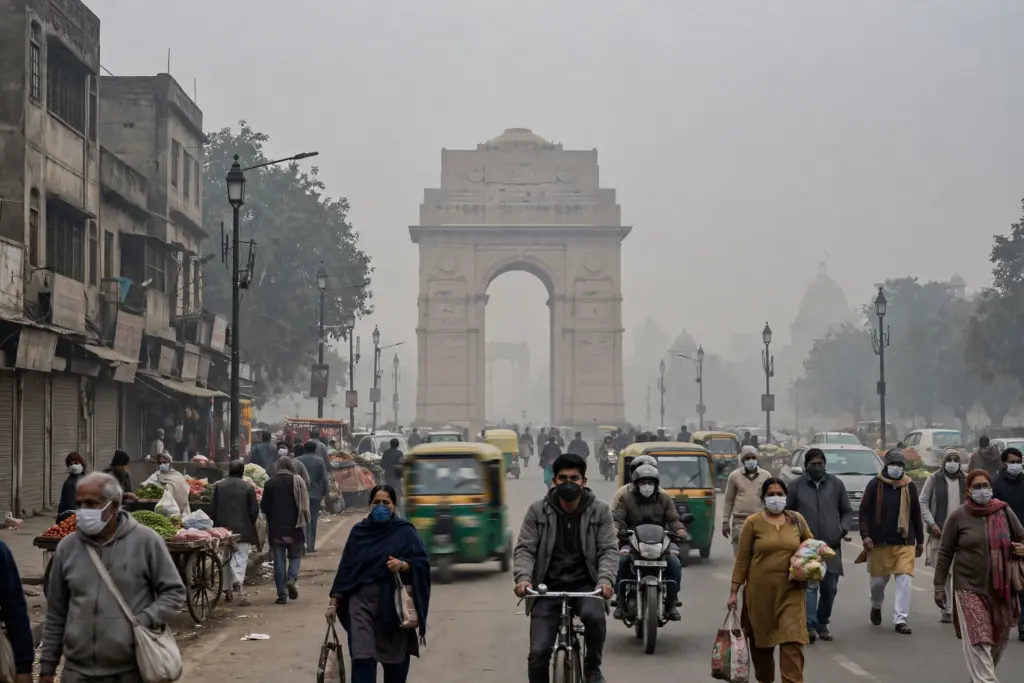
Delhi’s air stayed in the “very poor” category for the fourth day in a row on Friday, 6 November 2026, with the city’s 24-hour average Air Quality Index (AQI) at 389 at 8 AM, according to the Central Pollution Control Board (CPCB). That is up from 369 on Thursday. Eighteen of the city’s 59 monitoring stations recorded “severe” air, and the forecast says the air will turn severe across the city before Diwali on 8 November.
Where the air is worst today
Several parts of Delhi were already in the severe band this morning:
- IIT Delhi and Rohini: AQI 474
- Punjabi Bagh: 465
- RK Puram: 443
- ITO: 422
- Feroz Shah Road: 420
- India Gate: 403
- Jahangirpuri: 454 (recorded at 4 PM on Thursday, the highest in the city)
- Anand Vihar: 359, IGI Airport Terminal 3: 385, Aya Nagar: 393, Chandni Chowk: 391 — all “very poor”
On the CPCB scale, 0 to 50 is good, 51 to 100 is satisfactory, 101 to 200 is moderate, 201 to 300 is poor, 301 to 400 is very poor, and 401 to 500 is severe. The main pollutant is PM2.5 — the fine particles that settle deep in the lungs and carry the greatest risk for children, older adults and people with asthma or heart disease.
What the forecast says
The Air Quality Early Warning System expects Delhi’s air to stay “very poor” today and deteriorate to “severe” from 6 to 8 November, covering Diwali day itself. The outlook for the following six days is that pollution will keep swinging between severe and very poor. The Decision Support System for Air Quality Management expects the contribution of stubble burning to fall sharply on 7 November, while the share of vehicle emissions rises. The India Meteorological Department forecasts shallow fog over the next four days, turning into early morning fog or mist on 10 and 11 November.
GRAP Stage II is in force — what it means
The Commission for Air Quality Management (CAQM) invoked Stage II of the Graded Response Action Plan (GRAP) across Delhi-NCR on 2 November, after the AQI crossed into the very poor band. Stage I had been in force since 21 October. Stage II brings measures at pollution hotspots, more mechanised sweeping and water sprinkling on roads, and tighter regulation of diesel generators.
Stage III has not been invoked yet. It is the next step, and it comes when the AQI stays in the severe band of 401 to 450. Stage III would bring restrictions on BS-III petrol and BS-IV diesel vehicles in Delhi-NCR and possible hybrid classes for younger schoolchildren. If the forecast is right and the city average crosses 400 and stays there, Stage III is the step to watch for.
Separately, the CAQM has already ordered 50% office attendance in Delhi-NCR from 5 to 20 November, with the rest working from home, to cut down traffic during the worst pollution days.
What you should do
- Avoid morning walks and outdoor exercise until the air improves, especially if you have asthma, heart disease or are over 60.
- Wear an N95 mask outdoors — ordinary cloth and surgical masks do not filter PM2.5.
- Keep windows shut during the early morning and late evening, when pollution peaks.
- Children should stay indoors as much as possible; schools should follow CAQM and Delhi government directions on timings and outdoor activities.
- Do not burn waste or leaves — open burning is banned under GRAP, and firecracker smoke over Diwali will add to air that is already severe. The Supreme Court has allowed only certified green crackers in Delhi-NCR on 7 and 8 November, and only between 6 and 7 AM and 8 and 10 PM.
Related articles on HimachalGovt
- Delhi-NCR 50% Office Attendance, CAQM Order 5–20 November, AQI 367 — https://himachalgovt.com/stories/delhi-ncr-50-percent-office-attendance-caqm-pollution-order
- Delhi Diwali 2026: Green Crackers Allowed on 7 and 8 November Only, Timings and Rules — https://himachalgovt.com/stories/delhi-diwali-green-crackers-supreme-court-timings-rules
- Delhi Air Severe on 5 November: What GRAP Stage II Means for You — https://himachalgovt.com/stories/delhi-air-severe-5-nov