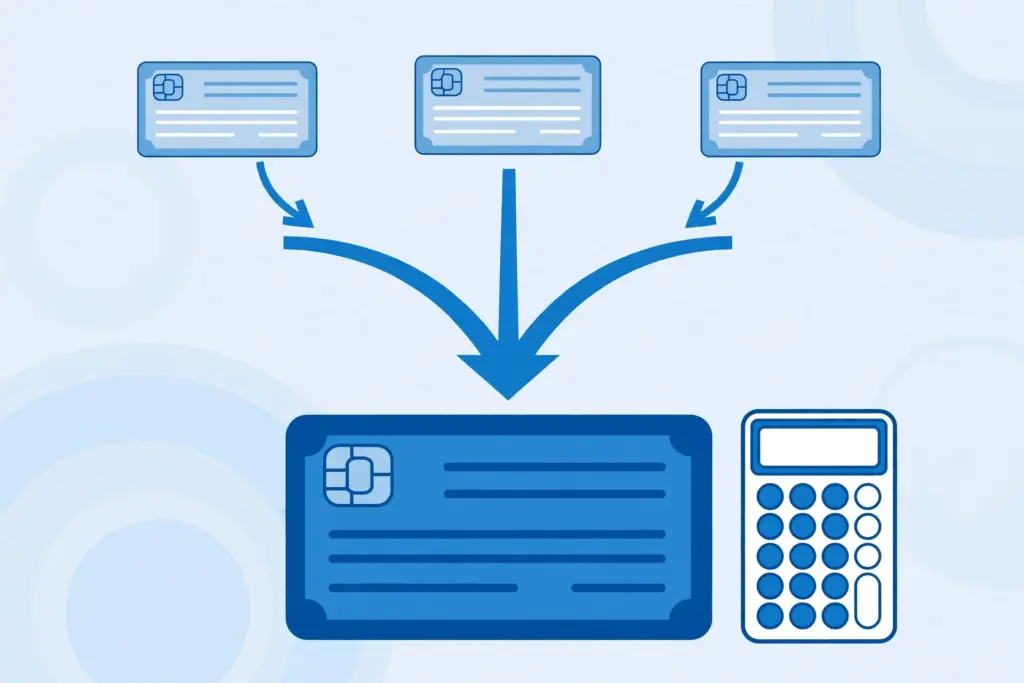
If you are paying several credit cards at once, a debt consolidation loan can turn them into one payment. It only saves money in the right situation. This is a general-education guide, not financial advice.
How it works
A consolidation loan is usually an unsecured personal loan that pays off several debts, leaving you with one fixed payment at one fixed rate, typically over 2–7 years.
When it saves money
It saves money only if the new APR — including fees — is below the average rate you pay now. Compare the numbers before you sign:
- Average bank 24-month personal loan: 11.9% (Federal Reserve, August 2026)
- Credit cards assessed interest: 22.36% on average
- Personal loan APR by credit score (loans closed October 2025 – September 2026): excellent credit (800–850) 9.43%, good credit (670–739) 18.68%, fair credit (580–669) 28.27%
Watch out for these
- Origination fees of 0–12% are common — they add to the real cost.
- The debt does not disappear — it just moves into one loan.
- If you run the cleared cards back up, you end up with the loan plus new card balances.
- US credit-card balances rose to $1.263 trillion in Q2 2026 (Federal Reserve Bank of New York) — if balances keep growing, consolidation alone does not fix the problem.
Related articles on HimachalGovt
- Debt Payoff: Snowball vs Avalanche in the USA — Which Method Works Better? — https://himachalgovt.com/stories/debt-payoff-snowball-vs-avalanche-in-the-usa-which-method-works-better/
- Personal Loan vs Balance Transfer Card in the USA: Which One Fits Your Debt? — https://himachalgovt.com/stories/personal-loan-vs-balance-transfer-card-in-the-usa-which-one-fits-your-debt/
- How to Build a Credit Score from Zero in the USA — https://himachalgovt.com/stories/how-to-build-a-credit-score-from-zero-in-the-usa-a-simple-beginners-guide