Home/Culture/Place/Complete Culture and Heritage of Una District: A Confluence of Punjabi and Pahari Traditions
PlaceUna|1 week ago
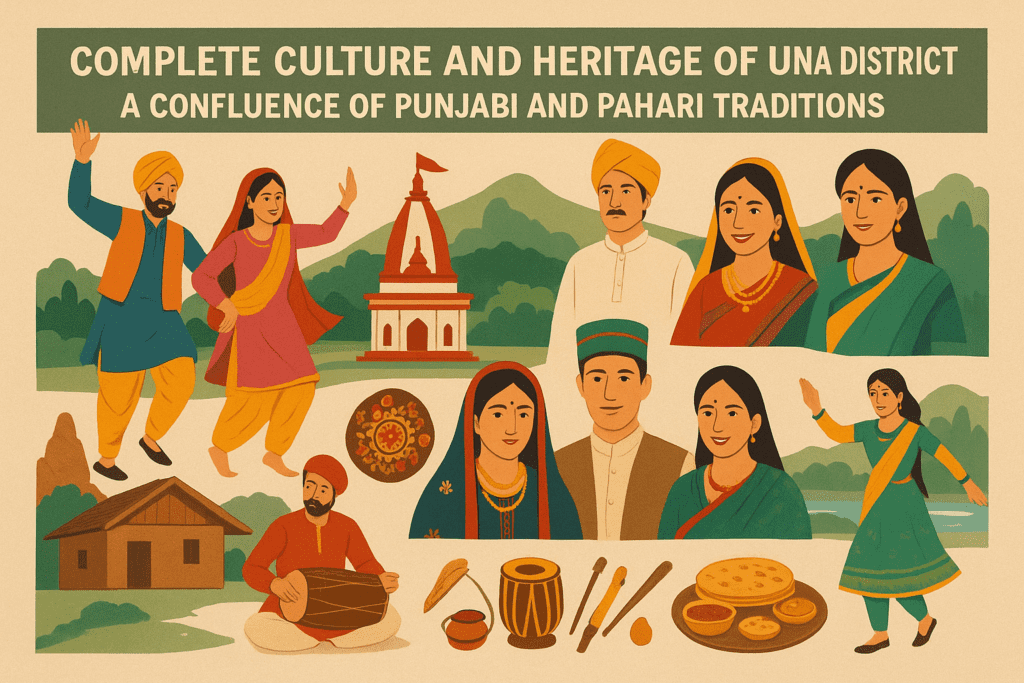
Complete Culture and Heritage of Una District: A Confluence of Punjabi and Pahari Traditions
Una district, often referred to as the gateway to Himachal Pradesh, is located in the state’s southwestern corner, bordering Punjab. This unique geographical position has blessed Una with a rich cultural tapestry where the vibrant traditions of Punjab meet the deeply rooted customs of the lower Pahari (hill) region, making it distinct from the deeper […]
Z
By Zenx H.P
Senior Correspondent
Representative Image
Table of Contents
01 1. 📜 History and Princely Legacy
02 2. 🗣️ Language and Sociolinguistics
03 3. 🙏 Religion and Key Pilgrimage Sites
04 4. 🎊 Fairs and Festivals
05 5. 🍲 Economy and Lifestyle
Una district, often referred to as the gateway to Himachal Pradesh, is located in the state’s southwestern corner, bordering Punjab. This unique geographical position has blessed Una with a rich cultural tapestry where the vibrant traditions of Punjab meet the deeply rooted customs of the lower Pahari (hill) region, making it distinct from the deeper Himalayan valleys.
1. 📜 History and Princely Legacy
Una’s history is marked by the influence of powerful Rajput clans and Sikh religious figures.
Rajput Principalities: The region was historically part of the feudal states of Jaswan and Kutlehar, both offshoots of the powerful Katoch dynasty of Kangra. The Jaswan state was established around 1170 AD.
Sikh Influence: Una holds immense spiritual significance for the Sikh faith:
Baba Sahib Singh Bedi, a descendant of Guru Nanak Dev Ji, was granted the Una taluka (administrative division) as a jagir (land grant) by Maharaja Ranjit Singh. The descendants still reside at the Kila Baba Bedi Sahib.
Guru Gobind Singh Ji also visited the area, commemorated by a historic gurudwara in Salori village.
The Swan River: The district’s main river, Swan, is mentioned in ancient Hindu scriptures, known as the “Soma Bhadra” in the Ramayana and “Swastu” in the Rigveda.
2. 🗣️ Language and Sociolinguistics
The language spoken in Una clearly reflects its inter-state location and cultural mix:
Pahari Influence: In the upper regions and Bangana tehsil, the local Pahari dialect is prevalent.
Punjabi Dominance: Due to its proximity to Punjab, especially in the plains areas like Haroli and Una town, Punjabi is widely spoken and understood, often blending with Hindi to form a local Hinglish/Punjabi mix.
Official Languages: Hindi is the official language, though both Hindi and Punjabi are commonly used in daily life and business.
3. 🙏 Religion and Key Pilgrimage Sites
Una is a vital hub for religious tourism, drawing millions of pilgrims annually, particularly from North India.
Religious Site
Significance
Maa Chintpurni Temple
One of the 51 Shakti Peethas, dedicated to Goddess Chhinnamastika. It is one of the most revered Hindu pilgrimage centers in North India.
Kila Baba Bedi Sahib
The ancestral residence of the descendants of Guru Nanak Dev Ji and a significant Sikh historical and religious site.
Dera Baba Barbhag Singh
Located in Mairi village, this is an important pilgrimage site for both Hindus and Sikhs, especially famous during the Hola Mohalla fair.
Shiv Bari Temple, Gagret
An ancient Shiva temple believed to be the practice ground for archery by the disciples of Guru Dronacharya.
4. 🎊 Fairs and Festivals
Festivals in Una are celebrated with the enthusiasm characteristic of the Punjab region, combined with traditional Pahari rituals.
Lohri: The winter harvest festival is celebrated with great zeal, marked by bonfires, traditional dances, and folk songs.
Navratri Melas: Huge fairs are held twice a year (Chaitra and Ashvin) at the Chintpurni Temple, attracting massive crowds of devotees.
Holi: While celebrated with colors across the district, the celebrations often include unique local traditions and community feasts.
Peer Nigaha Fair: A prominent annual fair held at the Pir Nigaha Shrine in Basoli village.
5. 🍲 Economy and Lifestyle
Una’s economy is highly dependent on its geography as a border district, relying heavily on agriculture and industry.
Economy:
Agriculture: The economy is primarily agrarian, with crops like wheat, maize, and rice being staples. The fertile plains support intensive farming.
Industrial Hub: The district hosts several industrial areas (like Mehatpur, Gagret, and Tahliwal), serving as a significant industrial gateway to Himachal due to excellent connectivity to Punjab.
Cooperative Heritage: Una holds the historical distinction of being the location of India’s first informal cooperative society, established in Panjawar village in 1892.
Lifestyle & Cuisine: The daily diet is typical of North India, including rice, wheat rotis, and lentils. However, traditional Himachali dishes like Madra and Dhaam (community feasts) are prepared during religious and social festivals, preserving the distinct hill cuisine.